
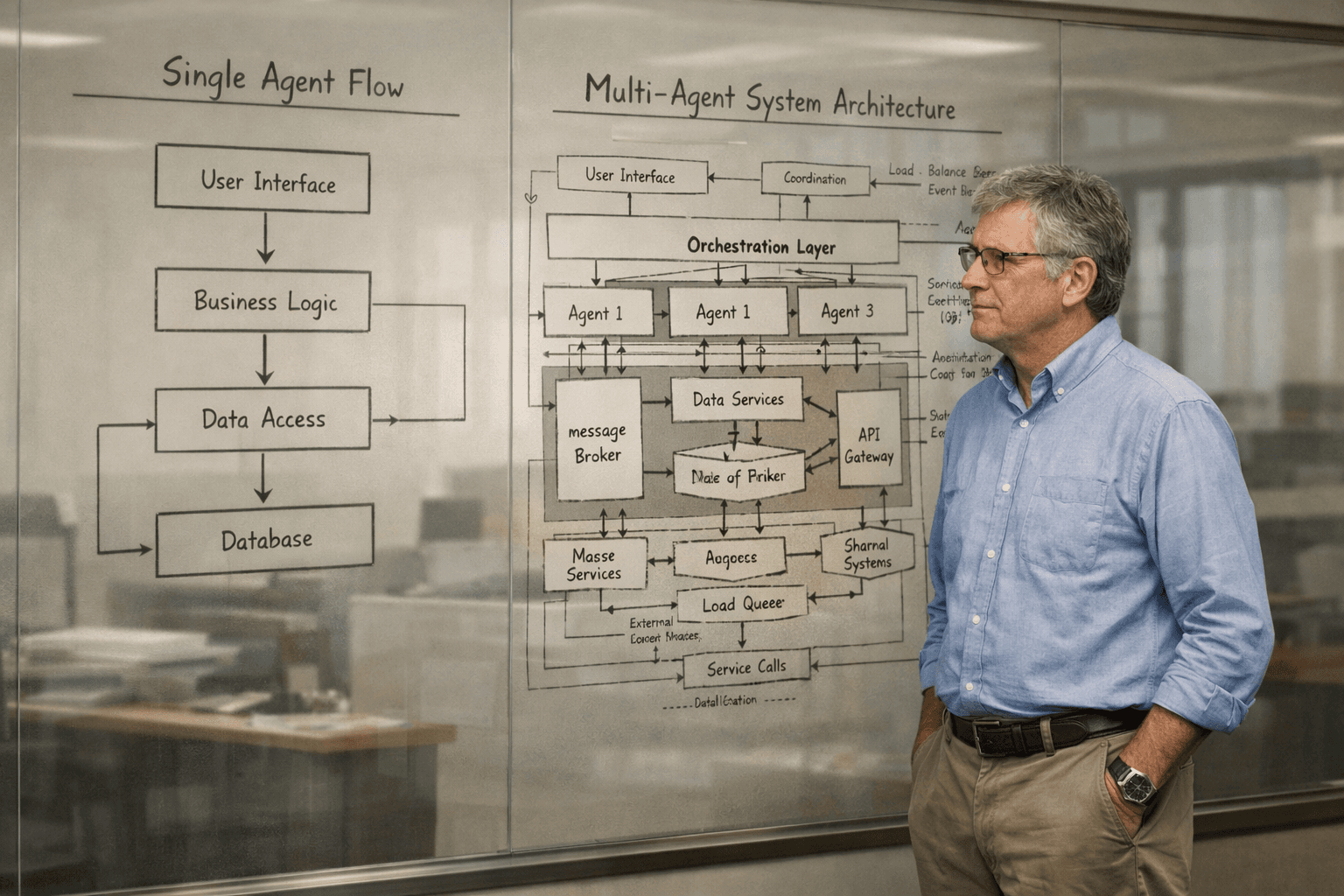
Single-Agent vs Multi-Agent Systems: How to Choose
Most teams reach for multi-agent systems far too early. They mistake architectural complexity for sophistication, and orchestration diagrams for progress. I’ve watched smart engineers fragment a perfectly capable single agent into a brittle swarm, only to spend the next six months debugging coordination bugs that never needed to exist. The uncomfortable truth is this: most “multi-agent” problems are really discipline problems. You don’t need more agents. You need clearer boundaries, better state management, and the courage to say no to premature autonomy.
That stance makes people uneasy. Good. It should.
I’ve been building agentic systems long enough to see the pattern repeat. Someone demos a planner agent talking to a researcher agent calling a tool agent, and suddenly every production workflow looks underpowered. But the systems that survive contact with users, load, and failure modes tend to be simpler than the conference slides suggest. Choosing between a single-agent and a multi-agent architecture is less about ambition and more about operational honesty.
Before we talk about when to split agents apart, we need to get clear on what breaks first when you don’t.
A single agent, properly designed, can already decompose tasks, call tools, maintain internal state, and respect autonomy boundaries. Modern models are perfectly capable of running structured loops where planning, execution, and verification happen within one controlled context. The limiting factor isn’t intelligence. It’s coordination overhead, observability, and failure containment. When those start hurting, that’s when architecture matters.
If you want a broader grounding in how agentic systems evolve from prototypes to production, there’s a deeper walkthrough in AI Agents: A Practical Guide for Building, Deploying, and Scaling Agentic Systems , which covers the lifecycle mistakes teams keep repeating once agents leave the lab.
When to use a single-agent system
Use a single-agent system when you can still draw a straight line between intent, action, and outcome. That’s the real test. If one agent can own the entire task lifecycle without ambiguous handoffs, splitting it up will only add friction.
Single-agent systems shine when the problem space is cohesive. A support agent that retrieves policy docs, reasons over user context, and triggers a refund API call doesn’t benefit from being three agents arguing with each other. The moment you externalize reasoning into multiple agents, you introduce coordination overhead that has to be justified by real gains, not aesthetic ones.
State management is another quiet advantage. With one agent, state is local, explicit, and inspectable. You can snapshot it, replay it, and reason about failure modes with relative confidence. Once you distribute state across agents, you’re forced to invent synchronization strategies, versioning rules, and recovery logic. Most teams underestimate how quickly that complexity compounds under load.
There’s also latency. Every agent boundary adds model calls, serialization, and retry logic. In isolation, it feels negligible. In aggregate, it becomes the difference between a responsive system and one that feels sluggish and unpredictable. If your user-facing workflow has tight latency constraints, a single agent with well-structured tool calling will almost always outperform a loosely coordinated group.
Human-in-the-loop scenarios are another strong argument for staying single-agent longer than you think. When a human needs to intervene, review, or override decisions, a single agent provides a clean control surface. You know where decisions are made and where to intercept them. In multi-agent systems, responsibility diffuses quickly. If you care about auditability and trust, that diffusion is a liability, not a feature. This is explored in more depth in Human-in-the-Loop Design for Production AI Agents , especially where agent autonomy collides with real operational accountability.
Most importantly, single-agent systems force you to be disciplined. They push you to design better prompts, clearer tool interfaces, and tighter autonomy boundaries. If you can’t make a single agent reliable, adding more agents won’t save you. It will just hide the problem behind orchestration.
When multi-agent systems make sense
Multi-agent systems make sense when ownership boundaries are real, stable, and unavoidable. Not imagined. Not “future-proofed.” Real.
The clearest signal is when tasks can proceed independently and asynchronously without constant coordination. If agents can work in parallel on genuinely separable concerns, and their outputs don’t need continuous negotiation, you’re finally in multi-agent territory that earns its keep. Think long-running research tasks feeding into a synthesis agent, or monitoring agents operating independently from execution agents.
Another valid trigger is failure isolation. When a failure in one part of the system must not contaminate others, splitting agents can act as a blast-radius limiter. This only works if you enforce hard boundaries. If agents share mutable state or implicit assumptions, you lose that benefit immediately.
There’s also organizational reality. Sometimes multi-agent architectures mirror team structures. Different teams own different agents, with clear contracts and interfaces. When done intentionally, this can align technical boundaries with human ones. When done accidentally, it becomes a mess of half-owned logic and finger-pointing. The architecture doesn’t save you from org problems, but it can amplify them.
Multi-agent systems also become necessary when autonomy levels diverge sharply. If one agent must operate under strict constraints and approvals while another can act freely, forcing them into a single control loop creates awkward compromises. Separate agents let you enforce different policies without turning one prompt into a legal document.
That said, coordination overhead is the tax you always pay. Agents need protocols, shared schemas, and conflict resolution strategies. You’re now designing distributed systems, whether you like it or not. If your team doesn’t have experience with distributed failure modes, eventual consistency, and observability, you’re signing up for a painful learning curve. Reading about Common AI Agent Architecture Patterns helps here, but patterns don’t eliminate the cost. They just make it visible sooner.
Single-agent vs multi-agent performance tradeoffs
Performance tradeoffs between single-agent and multi-agent systems are less about raw throughput and more about predictability. Single agents are boring in a good way. They fail in fewer, more comprehensible ways. Multi-agent systems fail creatively.
In a single-agent setup, performance bottlenecks are usually model latency or tool execution time. You can profile them, cache aggressively, and optimize incrementally. In multi-agent systems, bottlenecks often emerge from coordination itself. Agents wait on each other, retry conflicting actions, or stall due to partial state updates. These issues are notoriously hard to reproduce.
Scalability is another misunderstood dimension. People assume multi-agent systems scale better because “work is distributed.” In practice, many workloads scale horizontally just fine with replicated single agents behind a queue. You get parallelism without coordination. Multi-agent systems only outperform here when agents truly need to specialize and operate concurrently on different aspects of the same problem.
Cost is the quiet killer. Every agent interaction is a billable event. Multiply that by retries, guardrails, and verification loops, and your inference costs can balloon without delivering proportional value. I’ve seen teams shocked when their elegant agent mesh costs ten times more than a blunt single-agent solution that users actually prefer.
There’s also cognitive performance. A single agent with a well-designed prompt and structured scratchpad often reasons more coherently than a committee of agents passing summaries back and forth. Every handoff compresses information. Subtle context gets lost. Decisions degrade. If correctness matters more than theatrics, that should worry you.
This is where prompt discipline matters more than architecture. Teams often blame the agent count when the real issue is sloppy instruction design. If your agents hallucinate, ignore constraints, or misuse tools, splitting them up won’t fix it. It will multiply it. That’s why Prompt Engineering for Agents (Not Chatbots) keeps resurfacing in postmortems. Agents don’t fail because they’re alone. They fail because we ask them vague questions and expect deterministic behavior.
Now, a brief digression, because this is where people usually push back.
I’ve had founders tell me they need multi-agent systems because investors expect them. The demo looks more impressive. The architecture diagram feels more “AI-native.” I get the pressure. I’ve been in those rooms. But production systems don’t care about your pitch deck. They care about uptime, cost, and the number of times someone gets paged at 3 a.m.
I’ve also seen teams go multi-agent because they wanted to experiment, not because the problem demanded it. That’s fine in research. It’s reckless in production. Exploration is not an excuse to externalize complexity onto users and operators.
And yes, there are cases where multi-agent systems unlock capabilities that single agents can’t reach cleanly. But those cases announce themselves loudly. You don’t have to squint to justify them.
Back to the point.
Choosing between single-agent and multi-agent systems is ultimately a question of control. How much uncertainty are you willing to manage? How much coordination debt can your team service over time? The right answer is usually more conservative than people expect.
Start with a single agent. Push it hard. Add structure, memory boundaries, and explicit tool contracts. Observe where it breaks under real workloads. Only then consider splitting responsibilities, and do it surgically. One additional agent at a time, with a clear reason for its existence.
Multi-agent systems are powerful, but they’re not forgiving. They demand maturity in engineering, monitoring, and organizational alignment. If you don’t already have that maturity, they will expose it mercilessly.
If you’d benefit from a calm, experienced review of what you’re dealing with, let’s talk. Agents Arcade offers a free consultation.
Majid Sheikh is the CTO and Agentic AI Developer at Agents Arcade, specializing in agentic AI, RAG, FastAPI, and cloud-native DevOps systems.