Human-in-the-Loop Design for Production AI Agents
At some point, every team with “successful” agents hits the same wall. The agent keeps working. The metrics look fine. Tickets are closed. And yet, a week later, you discover it’s been confidently approving refunds it shouldn’t, escalating the wrong customers, or quietly corrupting downstream data. Nothing crashed. Nothing alerted. The agent did exactly what it was told to do—just not what you meant.
That’s the uncomfortable truth of production AI. The most dangerous failures don’t look like failures. They look like smooth, automated progress.
I’ve shipped enough agentic systems to stop romanticizing autonomy. Full autonomy isn’t a badge of engineering maturity. In most real systems, it’s a liability you pay for later.
Human-in-the-loop design isn’t about mistrust. It’s about acknowledging how these systems actually fail, and designing for that reality instead of pretending we’ll prompt our way out of it.
The quiet lie of “mostly autonomous” systems
On architecture diagrams, agents are clean. Inputs go in. Tools get called. Outputs come out. In production, everything smears.
Agents don’t fail like APIs. They don’t throw exceptions when they’re wrong. They produce plausible outputs that drift just enough to pass superficial checks. Confidence becomes the enemy. The more articulate the model, the harder it is to notice it’s off the rails.
This is where autonomy breaks down at scale. As soon as agents touch money, users, or irreversible actions, error tolerance collapses. A one-percent silent failure rate isn’t a rounding error; it’s a business problem. This is why anyone serious about scaling agentic systems eventually revisits the architectural foundations covered in a practical guide to building and scaling agentic systems .
Human-in-the-loop is not a fallback for weak systems. It’s the control surface that lets strong systems survive contact with reality.
How human-in-the-loop improves AI agent reliability
Reliability doesn’t come from making agents smarter. It comes from bounding the damage they can do when they’re wrong.
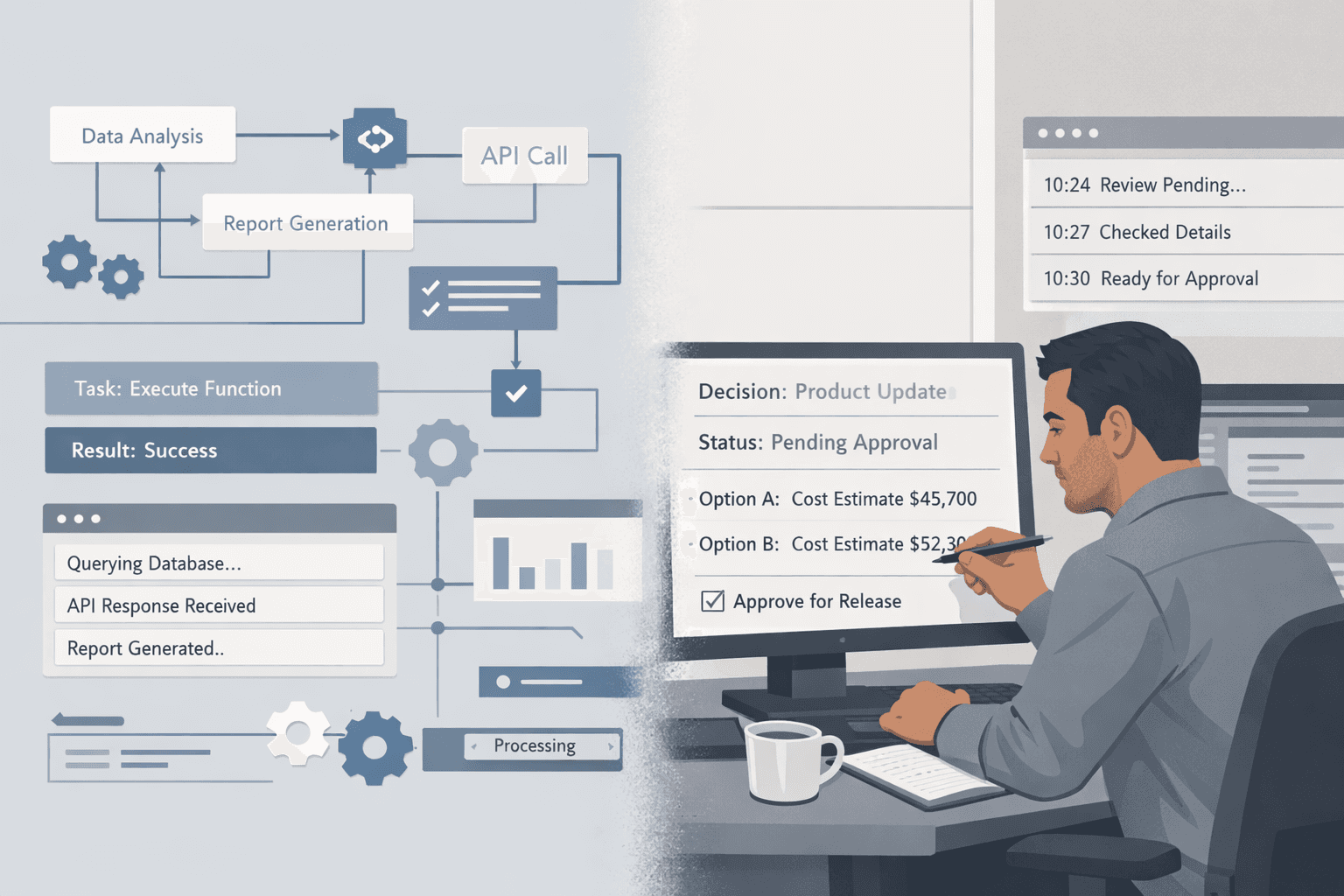
Human oversight improves reliability because it converts unknown failure modes into observable ones. When an agent knows that certain decisions will be reviewed, escalated, or audited, you gain leverage over the system’s behavior. Not because the model “tries harder,” but because the system design creates choke points where errors can’t silently propagate.
In practice, this shows up in three places.
First, confidence thresholds. Agents are excellent at producing answers even when uncertainty is high. Humans are much better at recognizing when uncertainty matters. Routing low-confidence or high-impact decisions through a human immediately raises system reliability, even if the agent logic itself doesn’t change.
Second, semantic validation. Agents often pass syntactic checks while violating business intent. A human reviewer understands context the system doesn’t encode: timing, nuance, reputational risk. This isn’t about manual labor; it’s about catching the category of errors models are structurally bad at noticing.
Third, feedback loops. When humans correct agents in production, you’re not just fixing an output. You’re generating high-quality, domain-specific signals that improve prompts, policies, and tool contracts. Systems without this loop stagnate. Systems with it get sharper over time.
Reliability emerges from supervision, not bravado.
Autonomy isn’t binary, and pretending it is causes damage
One of the more persistent myths in agent design is that systems are either autonomous or supervised. That framing is lazy, and it leads to brittle designs.
In reality, autonomy exists on a gradient. Agents can draft, suggest, pre-approve, batch, or execute depending on context. The mistake is locking the entire workflow into a single autonomy mode because it looked elegant during early demos.
This is especially obvious once you move beyond trivial single-agent flows. Teams discover—often painfully—that coordination amplifies failure. An upstream agent’s small mistake becomes a downstream agent’s unquestioned input. By the time the output reaches a human, it’s been laundered through multiple steps and feels authoritative. This is why architectural choices around agent topology matter more than prompt cleverness, a point that often surfaces when comparing approaches like single-agent pipelines versus more complex setups discussed in how to choose between single-agent and multi-agent systems .
Human-in-the-loop design forces you to decide where autonomy actually belongs instead of defaulting to “everywhere.”
When to add human oversight to AI agents
The wrong question is whether your agent needs human oversight. The right question is where you can afford not to have it.
There are three signals that tell you oversight is overdue.
The first is irreversible impact. If an agent’s action can’t be cleanly undone—financial changes, user trust, regulatory exposure—you need a human gate. Not later. Not after a few incidents. From day one.
The second is ambiguous success criteria. Agents struggle when “correct” depends on judgment rather than rules. If your team debates edge cases in meetings, your agent will mishandle them in production. That’s a design smell, not a model limitation.
The third is distribution shift. As soon as inputs change faster than your training or prompting assumptions, autonomy becomes risky. Humans adapt to novelty. Agents extrapolate confidently. Oversight is how you bridge that gap.
Ignoring these signals doesn’t make the system more advanced. It just delays the incident review.
The failure modes no dashboard will warn you about
This is the part teams usually learn the hard way.
Over-automated systems fail quietly. The agent keeps producing outputs that are internally consistent but externally wrong. Monitoring shows throughput, latency, success rates—all green. The problem only surfaces when a customer complains or a downstream metric degrades weeks later.
I’ve seen agents slowly bias themselves toward the easiest resolution path because nothing in the system penalized that behavior. I’ve seen escalation logic that technically worked but never triggered because the confidence scoring was self-referential. I’ve seen entire feedback loops collapse because no one owned the human review queue, so corrections stopped flowing.
These weren’t model failures. They were design failures. The system optimized for flow, not truth.
The fix wasn’t a better model. It was reintroducing friction in the right places. A review step here. A forced pause there. A human acknowledgment that certain decisions deserved attention.
Once those controls were in place, performance improved. Not because automation was reduced, but because it was finally grounded.
And yes, this feels like heresy when you’re deep in automation culture. But production doesn’t reward purity. It rewards systems that fail loudly and early.
Now, back to the core point.
Designing human escalation paths for AI systems
Escalation isn’t an error condition. It’s a first-class feature.
Most teams bolt escalation on after incidents. That’s backwards. Escalation paths should be designed alongside the agent’s primary workflow, with as much care as tool calling or state management.
Effective escalation has three properties.
It’s intentional. You define upfront which decisions the agent is allowed to make alone, which require confirmation, and which must always be handed off. This isn’t guesswork. It’s policy encoded into the system.
It’s timely. Escalation that happens after damage is done is theater. Humans need to see the decision while it’s still malleable, not as a postmortem artifact.
It’s contextual. Dumping raw logs on a human reviewer is not oversight; it’s punishment. The agent must surface why it’s uncertain, what it considered, and what’s at stake. Good escalation feels like collaboration, not interruption.
When escalation paths are designed well, humans don’t feel like babysitters. They feel like supervisors with leverage.
Why “trust but verify” is not enough
There’s a comforting phrase teams like to use: trust but verify. In agentic systems, that mindset is insufficient.
Verification implies you know what to check. In practice, many failures happen outside the defined checks. Agents comply with the letter of the rules while violating their spirit. Verification passes. Damage accumulates.
Human-in-the-loop works because humans don’t just verify outputs; they interpret intent. They notice when something feels off even if it technically passes. That intuition is hard to encode and foolish to discard.
This doesn’t mean humans should review everything. It means they should be strategically positioned where intuition matters most.
Operationalizing oversight without killing velocity
The fear is always the same: humans will slow everything down. Sometimes that’s true. Often it’s a sign of poor design.
When oversight is integrated correctly, it doesn’t bottleneck the system. It shapes it. Agents learn which paths lead to friction and adapt upstream. Engineers get clearer signals about where logic breaks down. Product teams see where automation creates value versus noise.
The trick is treating human attention as a scarce resource and designing around it. Escalate fewer, higher-quality cases. Batch intelligently. Close the loop so corrections actually feed back into the system.
Velocity doesn’t come from removing humans. It comes from aligning them with the system’s weak points.
The uncomfortable conclusion
If you’re aiming for fully autonomous agents in production, you’re optimizing for the wrong thing.
Autonomy feels impressive. Oversight feels mundane. But the systems that last—the ones that survive audits, scale across teams, and earn real trust—are the ones that assume they’ll be wrong and plan accordingly.
Human-in-the-loop design isn’t a compromise. It’s an admission of maturity. It says you understand not just what these systems can do, but how they fail when no one is watching.
And if you’ve been up at 3 a.m. tracing a silent error through an agent that never technically broke, you already know this.
If you’d benefit from a calm, experienced review of what you’re dealing with, let’s talk. Agents Arcade offers a free consultation.
Majid Sheikh is the CTO and Agentic AI Developer at Agents Arcade, specializing in agentic AI, RAG, FastAPI, and cloud-native DevOps systems.