
AI Agents: A Practical Guide for Building, Deploying, and Scaling Agentic Systems
AI agents are no longer experimental demos or research curiosities. They are being deployed today to automate workflows, power customer support, coordinate internal operations, and interact with real-world systems through APIs and tools.
Unlike traditional chatbots that simply respond to user inputs, agentic AI systems are designed to reason, plan, take actions, and adapt over time. They can decide what to do, which tools to use, and how to achieve a goal—often with minimal human intervention.
This guide is written for builders, technical leaders, and businesses who want a practical understanding of AI agents—not theory. We’ll cover how agentic systems actually work in production, the architectures behind them, common failure modes, and what it takes to deploy them safely at scale.
If you’re exploring AI agents for real business use cases—rather than prototypes—this guide will give you the clarity to move forward with confidence.
How Agents Arcade Helps
At Agents Arcade, we help organizations move beyond experimentation by designing and deploying production-grade AI Support Agent development services that align with real business objectives.
Whether you’re:
- Exploring your first agentic use case
- Scaling an existing AI system
- Replacing brittle automation with intelligent workflows
We provide the expertise to build systems that are reliable, secure, and scalable.
What Are AI Agents (Beyond Chatbots)
At a high level, an AI agent is a system that can reason about a goal, decide what actions to take, and execute those actions using tools or APIs—often across multiple steps.
This is fundamentally different from traditional chatbots.
For a deeper, practical explanation of how AI agents think, plan, and act in real systems, see our guide on what an AI agent is from both a business and technical perspective.
Most chatbots are reactive. They wait for a user message, generate a response, and stop. AI agents, on the other hand, are goal-driven. They can plan ahead, maintain context, and take actions that move them closer to an objective—sometimes without continuous user input.
Chatbots vs AI Agents
Traditional Chatbots AI Agents
Respond to messages Act toward goals
Stateless or limited memory Persistent short- and long-term memory
Single-turn or simple flows Multi-step reasoning and planning
No real-world actions Execute tools and APIs
Scripted behavior Adaptive decision-making
An AI agent doesn’t just answer what something is—it can decide what to do next, whether that means querying a database, calling an external API, updating a CRM record, or asking a clarifying question before proceeding.
This distinction matters in production systems. As soon as an application requires autonomy, coordination, or real-world actions, a chatbot architecture quickly becomes insufficient. That’s where agentic systems come into play.
If you want a deeper comparison of how these systems differ in real deployments, see our detailed breakdown of AI Agents vs Chatbots.
Core Components of an Agentic System
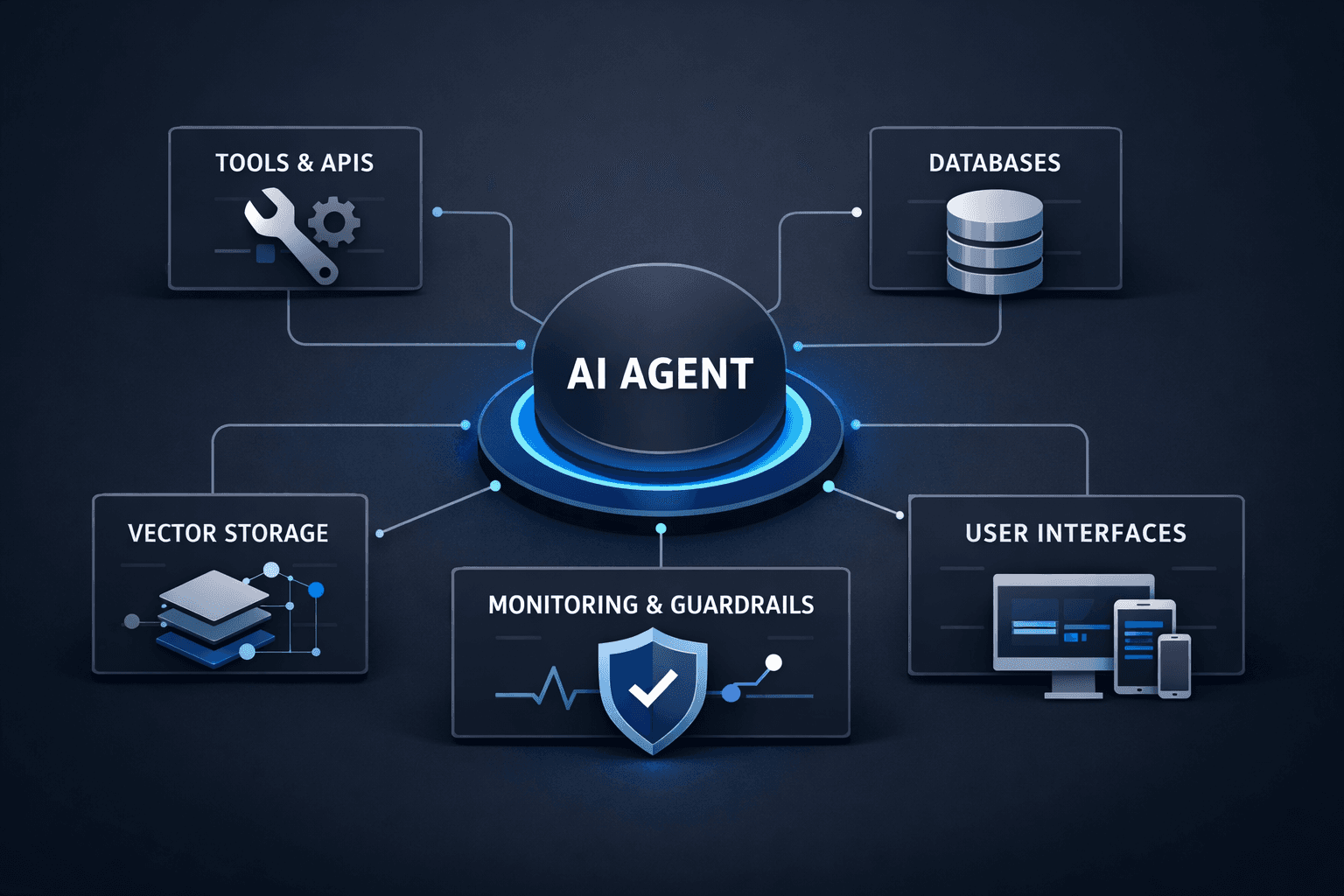
AI agents are not a single model or prompt. In production, an agentic system is a composition of multiple components working together to reason, decide, act, and recover from failure.
Understanding these components is critical if you want to build agents that are reliable, secure, and scalable.
1. The Reasoning Engine (LLM)
At the core of most AI agents is a large language model (LLM). The LLM is responsible for:
- Interpreting user intent
- Reasoning about goals
- Generating plans or next actions
However, in agentic systems, the LLM is not the system itself. It acts as a reasoning layer that proposes actions, which are then validated and executed by surrounding infrastructure.
In production environments, this often means:
- Constraining prompts
- Enforcing output schemas
- Separating reasoning from execution
This reduces hallucinations and keeps the agent’s behavior predictable.
2. Memory (State & Context Management)
Agents need memory to operate beyond a single interaction.
There are typically two types of memory:
- Short-term memory: Recent conversation state, intermediate reasoning, active goals
- Long-term memory: User profiles, historical actions, stored knowledge
Without memory, agents repeat themselves, lose context, and behave inconsistently. With poorly designed memory, they become slow, expensive, or unreliable.
Production systems treat memory as a first-class architectural concern, not an afterthought.
3. Tool Calling & External Actions
What makes agents powerful is their ability to interact with real systems.
Tools can include:
- Databases
- Internal APIs
- CRMs
- Payment systems
- Search engines
- File systems
The agent decides which tool to use, but the system decides whether the tool call is allowed. This separation is essential for security and cost control.
Modern agentic systems increasingly rely on standardized approaches to tool calling, including protocols like Model Context Protocol (MCP), to safely expose real-world capabilities to LLMs.
Tool execution is where many agent implementations fail. We cover this in detail in our guide to LLM Tool Calling and MCP.
4. Planning & Control Logic
Agents rarely act in a single step.
Instead, they follow a loop:
- Analyze the current state
- Plan the next action
- Execute a tool or request input
- Evaluate the result
- Continue or stop
This control logic can live:
- Inside the agent loop
- In an external orchestrator
- Across multiple cooperating agents
Clear control boundaries prevent infinite loops, runaway costs, and unpredictable behavior.
5. Safety, Guardrails & Observability
Production agents must operate within constraints.
This includes:
- Permission checks before tool execution
- Rate limits and cost controls
- Logging and traceability
- Human-in-the-loop escalation
- Without guardrails, agents can:
- Access unauthorized data
- Perform unintended actions
- Generate compliance risks
Safety is not optional—it’s part of the architecture.
Agentic Workflows Explained (How Agents Actually Operate)
While components define what an AI agent is made of, agentic workflows explain how those components work together at runtime.
In practice, AI agents operate as decision-making loops, not one-off responses. Each loop allows the agent to observe the current state, decide what to do next, take action, and evaluate the outcome before proceeding.
A simplified agentic workflow looks like this:
Input or Event
   ↓
State Analysis
   ↓
Planning
   ↓
Tool Execution
   ↓
Result Evaluation
   ↓
Next Action or Completion
This loop continues until the agent either reaches its goal, requires human input, or hits a predefined stopping condition.
Single-Agent vs Multi-Agent Workflows
Not all agentic systems are the same.
Single-agent workflows are best suited for:
- Customer support automation
- Knowledge assistants
- Task-focused automation
The agent maintains a single goal and operates within a well-defined environment.
Multi-agent workflows are used when:
- Tasks can be decomposed
- Coordination improves outcomes
- Specialized reasoning is needed
For example, one agent may plan, another may execute tools, and a third may evaluate results. These agents communicate through structured messages rather than free-form conversation.
Multi-agent systems add power—but also complexity. They require careful orchestration, clear roles, and strong observability to remain stable in production.
Event-Driven vs Loop-Based Agents
Another important distinction is how agents are triggered.
Event-driven agents react to:
- User actions
- System events
- Scheduled jobs
They perform a defined task and then stop.
Loop-based agents remain active:
- Monitoring conditions
- Iterating toward long-term goals
- Adapting to changing inputs
Loop-based agents are powerful, but they demand strict safeguards to avoid infinite execution or runaway costs.
Human-in-the-Loop Patterns
Fully autonomous agents are not always desirable.
In many real-world systems, the most reliable approach is partial autonomy, where:
- Agents propose actions
- Humans approve or override
- Feedback improves future behavior
This pattern is common in:
- Financial workflows
- Healthcare-related systems
- High-risk operational tasks
Human-in-the-loop design balances automation with control—making agentic systems practical rather than risky.
For a deeper breakdown of production patterns, see our guide on What Is an Agentic Workflow?
Production Reality: What Breaks First in Agentic Systems
Most agent demos work.
Most agent systems fail later — quietly, expensively, and in ways traditional software teams aren’t prepared for.
Once an AI agent moves beyond answering questions and starts planning, calling tools, and acting over time, a different class of problems shows up. These are not theoretical issues — they’re the ones that surface after real users, real data, and real budgets enter the picture.
Below are the failure points we see most often when agentic systems move from prototype to production.
Reliability Is the First Casualty
In production, agents rarely fail cleanly.
Instead of throwing obvious errors, they:
- Stall mid-workflow
- Partially complete tasks
- Loop while “thinking” they’re making progress
- Leave systems in inconsistent states after tool failures
This usually happens because agent workflows are stateful, long-running, and dependent on external systems that fail unpredictably.
If you don’t design for retries, checkpoints, and graceful exits from day one, reliability issues accumulate fast.
→ Deep dive: Error Handling in Agentic Systems
→ Related: Common AI Agent Architecture Patterns
Observability Is Not Optional (and Logs Aren’t Enough)
Traditional logging works for APIs.
It breaks down completely for agents.
When something goes wrong, teams often can’t answer basic questions:
- Why did the agent choose this action?
- Which step consumed the most tokens?
- Where did latency actually come from?
- Was the failure reasoning, tooling, or data?
Without step-level tracing, cost attribution per task, and visibility into tool usage, debugging becomes guesswork.
Production agents need observability designed into the workflow, not bolted on later.
→ Deep dive: Observability for AI Agents
→ Related: Scaling Strategies for AI Agent Backends
Cost Blowups Happen Quietly
Agent costs rarely spike overnight.
They creep.
The usual causes:
- Context windows growing without bounds
- Memory stores accumulating irrelevant data
- Redundant tool calls during planning loops
- Agents retrying “helpfully” when they shouldn’t
Because these systems are asynchronous and long-running, teams often notice the cost problem only after invoices arrive.
Cost control in agentic systems is an architecture concern, not a billing concern.
→ Deep dive: Cost Modeling for Agentic Systems
→ Related: Reducing Token Costs in Long-Running Agent Workflows
Latency Kills Adoption Faster Than Accuracy
Users will tolerate imperfect answers.
They will not tolerate slow automation.
Agent latency compounds quickly:
- Cold starts
- Sequential tool calls
- Over-orchestrated graphs
- Excessive planning steps
What feels acceptable in a demo becomes unusable in production, especially for user-facing workflows.
Streaming, parallelism, and aggressive caching are not optimizations — they’re survival tactics.
→ Deep dive: Cold Starts, Latency, and Streaming in Agent-Based Systems
→ Related: Caching Strategies for Agent Responses and Tool Calls
Security and Control Are Usually Afterthoughts
The moment an agent can act, not just respond, it becomes a security surface.
Common production risks include:
- Prompt injection via retrieved data
- Over-permissive tool access
- Data leakage across sessions or users
- Agents executing unintended actions with valid credentials
Without clear boundaries, audits, and human-in-the-loop controls, agent systems can do real damage — even when they’re “working as designed.”
→ Deep dive: Security Risks in AI Agent Architectures
→ Related: Human-in-the-Loop Design for Production AI Agents
Ownership Becomes Unclear — Until Something Breaks
When an agent fails at 2 a.m., someone owns it — even if no one planned for that.
Teams often underestimate:
- Who monitors agent health
- Who gets paged when workflows stall
- How humans intervene safely
- How systems recover from partial execution
Agentic systems blur the lines between product, engineering, and operations. Without explicit ownership models, failures turn into organizational problems, not just technical ones.
→ Deep dive: Who Owns an AI Agent in Production?
The Bottom Line
Agentic systems don’t fail because the models are weak.
They fail because production realities are ignored too long.
If you treat agents like chatbots, they will behave like unreliable automation.
If you treat them like distributed systems with probabilistic components, they can scale safely.
This guide covers the foundations.
The sections above cover what actually determines success once the demo is over.
Real-World Use Cases of AI Agents
AI agents deliver value when they are applied to clear business problems, not abstract tasks. Below are some of the most common and successful real-world use cases where agentic systems outperform traditional automation and chatbots.
Customer Support & Service Automation
Customer support is one of the earliest and most effective use cases for AI agents.
Unlike scripted chatbots, agentic support systems can:
- Understand user intent across multiple messages
- Retrieve accurate information from knowledge bases
- Take actions such as creating tickets or updating records
- Escalate to humans when confidence is low
The result is faster response times, reduced support costs, and improved customer satisfaction—without sacrificing control.
This approach is commonly implemented through AI support agents and conversational AI systems.
Internal Operations & Workflow Automation
Many organizations use AI agents to automate internal processes that previously required manual coordination.
Examples include:
- Processing internal requests
- Managing approvals
- Coordinating tasks across systems
- Generating reports or summaries
In these cases, agents act as orchestrators, connecting multiple tools and services while adapting to real-time conditions.
This reduces operational overhead and allows teams to focus on higher-value work.
Sales, Lead Qualification & CRM Automation
AI agents can support sales teams by:
- Engaging website visitors
- Qualifying leads through conversation
- Enriching lead data
- Updating CRM systems automatically
Rather than replacing sales teams, agents augment human workflows, ensuring that sales professionals spend time on qualified opportunities instead of repetitive tasks.
Knowledge Assistants & RAG-Powered Systems
For organizations with large volumes of internal documentation, AI agents can act as intelligent knowledge assistants.
By combining retrieval-augmented generation (RAG) with agentic workflows, these systems can:
- Search across internal documents
- Synthesize accurate responses
- Cite sources
- Maintain context across conversations
This is especially valuable for:
- Technical support teams
- Legal and compliance departments
- Internal enablement platforms
Why Use Cases Matter
Successful AI agent deployments are:
- Narrowly scoped
- Clearly measurable
- Integrated into existing systems
Broad, undefined agents tend to fail. Targeted agentic systems that solve real problems tend to scale.
If you’re exploring which use cases make sense for your organization, our team works with clients to identify where agentic AI delivers real ROI.
Common Mistakes When Building AI Agents
AI agent projects often fail not because the technology is immature, but because of poor design decisions early on. Below are the most common mistakes organizations make—and how to avoid them.
Treating AI Agents as Chatbots
One of the biggest mistakes is assuming an AI agent is just a conversational interface.
True agentic systems:
- Make decisions
- Call tools
- Execute workflows
- Adapt based on outcomes
When agents are built like chatbots, they quickly hit limitations and fail to deliver meaningful automation.
Overloading a Single Agent with Too Many Responsibilities
Trying to build “one agent to do everything” almost always leads to:
- Unpredictable behavior
- Poor reliability
- Difficult debugging
- High operational costs
Effective systems use multiple specialized agents, each responsible for a narrow task, coordinated through orchestration logic.
Ignoring Guardrails and Safety Controls
Uncontrolled agents can:
- Take incorrect actions
- Expose sensitive data
- Hallucinate responses
- Execute unintended workflows
Production-grade agentic systems must include:
- Input validation
- Output constraints
- Permission boundaries
- Human-in-the-loop checkpoints
Safety is not optional—it’s foundational.
Lack of Observability and Monitoring
Many teams deploy agents without visibility into:
- What decisions the agent is making
- Why failures occur
- How often tools are called
- Where latency or cost spikes happen
Without logging, tracing, and metrics, optimization becomes impossible.
Building Without a Clear Business Metric
AI agents should always be tied to measurable outcomes, such as:
- Reduced response time
- Lower operational cost
- Increased lead conversion
- Faster internal workflows
Projects without clear KPIs tend to stall or get deprioritized.
Why Avoiding These Mistakes Matters
The difference between a successful agentic system and a failed one is rarely the model—it’s the architecture, constraints, and intent behind it.
At Agents Arcade, we focus on building production-ready AI agents, not demos that break under real-world conditions.
Tools and Frameworks for Building AI Agents
Building reliable AI agents requires more than choosing a powerful language model. Production-ready agentic systems are assembled from a stack of tools that handle reasoning, orchestration, memory, integrations, and monitoring.
Below is a practical overview of the core components used to build modern AI agents.
Foundation Models (LLMs)
Large language models act as the reasoning engine behind AI agents. Depending on the use case, organizations may choose:
- Hosted models (e.g., OpenAI, Anthropic, Google)
- Open-source models deployed privately
- Hybrid approaches for cost and compliance control
The model choice matters, but architecture and constraints matter more.
Agent Orchestration Frameworks
Agent frameworks manage how agents think, decide, and act.
Common capabilities include:
- Tool calling
- Multi-agent coordination
- State management
- Memory handling
Popular frameworks in this space include:
- LangGraph
- LlamaIndex
- Custom orchestration layers built on top of APIs
These frameworks help transform raw LLMs into controllable, goal-driven agents.
Retrieval Systems and Vector Databases
For agents that need access to proprietary data, retrieval systems are essential.
These systems:
- Store embeddings in vector databases
- Retrieve relevant context at runtime
- Reduce hallucinations
- Enable domain-specific knowledge
Examples include:
- Qdrant
- Pinecone
- Weaviate
- Chroma
When combined with agent workflows, retrieval systems unlock knowledge-aware agents.
Tooling and Integrations
AI agents become useful when they can interact with real systems.
Common integrations include:
- CRMs
- Ticketing systems
- Databases
- Internal APIs
- Cloud services
Agents use tools to perform actions—not just generate text.
Monitoring, Logging, and Evaluation
Production deployments require visibility.
This includes:
- Decision tracing
- Tool call logging
- Latency and cost monitoring
- Automated evaluation and testing
Without observability, scaling agents safely becomes impossible.
Why Tooling Choices Matter
The wrong stack leads to brittle systems. The right stack enables:
- Scalability
- Reliability
- Security
- Maintainability
Our approach focuses on selecting and integrating tools that fit your business goals, not chasing trends.
How to Deploy and Scale AI Agents in Production
Moving from a working prototype to a production-ready AI agent requires careful planning. Many agent systems fail not during development, but during deployment and scaling.
Below is a practical approach to deploying and scaling agentic systems in real-world environments.
Start with a Controlled Deployment
Production deployment should begin with a limited scope.
Best practices include:
- Deploying to a staging environment
- Limiting initial user access
- Monitoring behavior closely
- Validating outputs before enabling automation
This allows teams to identify risks before full rollout.
Use Modular, Service-Oriented Architecture
Scalable agent systems are built as modular services, not monoliths.
This typically includes:
- Separate services for agents, tools, and retrieval
- API-based communication
- Stateless execution where possible
This architecture improves reliability and simplifies scaling.
Implement Guardrails and Human-in-the-Loop Controls
Not every decision should be automated.
Production systems often include:
- Confidence thresholds
- Approval workflows
- Escalation paths to humans
- Rate limits and permissions
These controls prevent errors while maintaining efficiency.
Optimize for Cost and Performance
As usage grows, so do costs.
Scaling responsibly involves:
- Caching responses
- Optimizing retrieval queries
- Using model routing strategies
- Monitoring token usage and latency
Cost optimization should be part of the deployment strategy from day one.
Continuously Evaluate and Improve
AI agents are not “set and forget” systems.
Ongoing improvement requires:
- Automated testing
- Feedback loops
- Performance evaluation
- Regular model and prompt updates
This ensures agents remain accurate as data and requirements evolve.
Why Production Readiness Matters
A demo that works once is not a system that works at scale.
At Agents Arcade, we design agentic systems that are secure, observable, and scalable—built for long-term operation, not short-term experimentation.
When Should You Build AI Agents vs Traditional Automation?
AI agents are powerful, but they are not always the right solution. Knowing when to use agentic systems—and when traditional automation is sufficient—is critical for long-term success.
When AI Agents Make Sense
AI agents are well-suited for problems that involve:
- Ambiguous or unstructured inputs
- Multi-step decision-making
- Dynamic workflows
- Natural language interaction
- Changing rules or data sources
Common examples include customer support, knowledge assistants, and complex workflow coordination.
In these scenarios, rigid rule-based systems quickly break down.
When Traditional Automation Is Enough
Traditional automation is often a better choice when:
- The workflow is deterministic
- Inputs and outputs are predictable
- Business rules rarely change
- Compliance requires strict control
Examples include scheduled jobs, fixed approval flows, and simple data transformations.
Using AI agents in these cases often adds unnecessary complexity.
Hybrid Approaches Work Best
In many real-world systems, the best solution is a hybrid approach.
This typically involves:
- Traditional automation handling predictable steps
- AI agents handling reasoning and decision-making
- Clear boundaries between both
This balance delivers flexibility without sacrificing reliability.
Why This Distinction Matters
Organizations that succeed with AI agents start with problem clarity, not technology enthusiasm.
If you’re unsure whether an AI agent is the right fit, a discovery phase can prevent wasted time and cost.
Choosing the Right AI Agent Development Partner
Selecting the right team to build agentic AI systems is as important as the technology itself. AI agents require expertise in architecture, tooling, orchestration, safety, and deployment—all areas where inexperienced providers can introduce risk.
What to Look for in a Partner
- Production Experience
- Proven deployments, not just prototypes
- Understanding of scalability, monitoring, and cost management
- Full-Stack Knowledge
- LLM reasoning engines
- Tool integration and workflow orchestration
- Memory and state management
- Business-Focused Solutions
- Alignment with KPIs and measurable outcomes
- Focus on ROI rather than experimental demos
- Safety and Compliance Awareness
- Guardrails, permissioning, and human-in-the-loop controls
- Secure handling of sensitive data
- Ongoing Support and Iteration
- Ability to update agents as business processes evolve
- Continuous evaluation and optimization
Why Agents Arcade
At Agents Arcade, we specialize in building production-ready AI agents tailored to your business. Our approach emphasizes:
- Discovery & Design: Understanding your goals and workflow requirements
- Custom Development: Selecting the right models, tools, and architectures
- Safe Deployment: Ensuring agents operate reliably, securely, and cost-effectively
- Continuous Improvement: Monitoring, feedback, and iterative optimization
Whether your goal is automating customer support, streamlining operations, or enhancing knowledge systems, we provide end-to-end solutions that deliver measurable results.
Ready to bring AI agents into your business?
Book a Free Consultation to discuss your project with our experts.
Frequently Asked Questions About AI Agents
What is the difference between an AI agent and a chatbot?
A chatbot primarily responds to user messages, usually following predefined flows.
An AI agent, on the other hand, can reason, make decisions, call tools, and execute actions across systems. Agents are designed to achieve goals, not just hold conversations.
Are AI agents safe to use in production?
Yes—when designed correctly.
Production-grade AI agents include:
- Guardrails and permissions
- Human-in-the-loop controls
- Monitoring and logging
- Secure data handling
Without these, agentic systems can become unpredictable.
How long does it take to build an AI agent?
Timelines vary based on scope and complexity.
- Simple agents: a few weeks
- Multi-agent systems with integrations: several weeks to a few months
A discovery phase helps define requirements and reduce delays.
Do AI agents require constant retraining?
Not always.
Many improvements come from:
- Updating prompts
- Refining tools and workflows
- Improving retrieval quality
Model retraining is only necessary in specific scenarios.
Can AI agents work with my existing systems?
Yes.
AI agents are commonly integrated with:
- CRMs
- Databases
- Support platforms
- Internal APIs
Most modern agent systems are designed to work within existing tech stacks.
What are the ongoing costs of running AI agents?
Costs typically include:
- Model usage
- Infrastructure
- Monitoring and maintenance
These costs scale with usage, but can be optimized through caching, routing, and efficient architecture.
Building AI Agents That Actually Work
AI agents represent a fundamental shift in how software systems operate—moving from static automation to goal-driven, adaptive systems. But success with agentic AI doesn’t come from model choice alone. It comes from clear problem definition, disciplined architecture, safety controls, and production readiness.
Organizations that approach AI agents strategically gain:
- More resilient automation
- Faster decision-making
- Scalable operational intelligence
- Better customer and employee experiences
Those that chase hype without structure often end up with brittle demos that fail under real-world conditions.
The difference is not ambition—it’s execution.
From Experimentation to Production
Building AI agents that actually work requires:
- Understanding where agentic systems add real value
- Designing for observability and safety from day one
- Integrating agents into existing workflows
- Continuously evaluating and improving performance
This is not a one-time project—it’s an evolving system.
Take the Next Step
If you’re considering AI agents for your business, the best place to start is with a focused conversation.
👉 Book a Free Consultation and let’s discuss how agentic AI can work for your organization.
Majid Sheikh is the CTO and Agentic AI Developer at Agents Arcade, specializing in agentic AI, RAG, FastAPI, and cloud-native DevOps systems.