
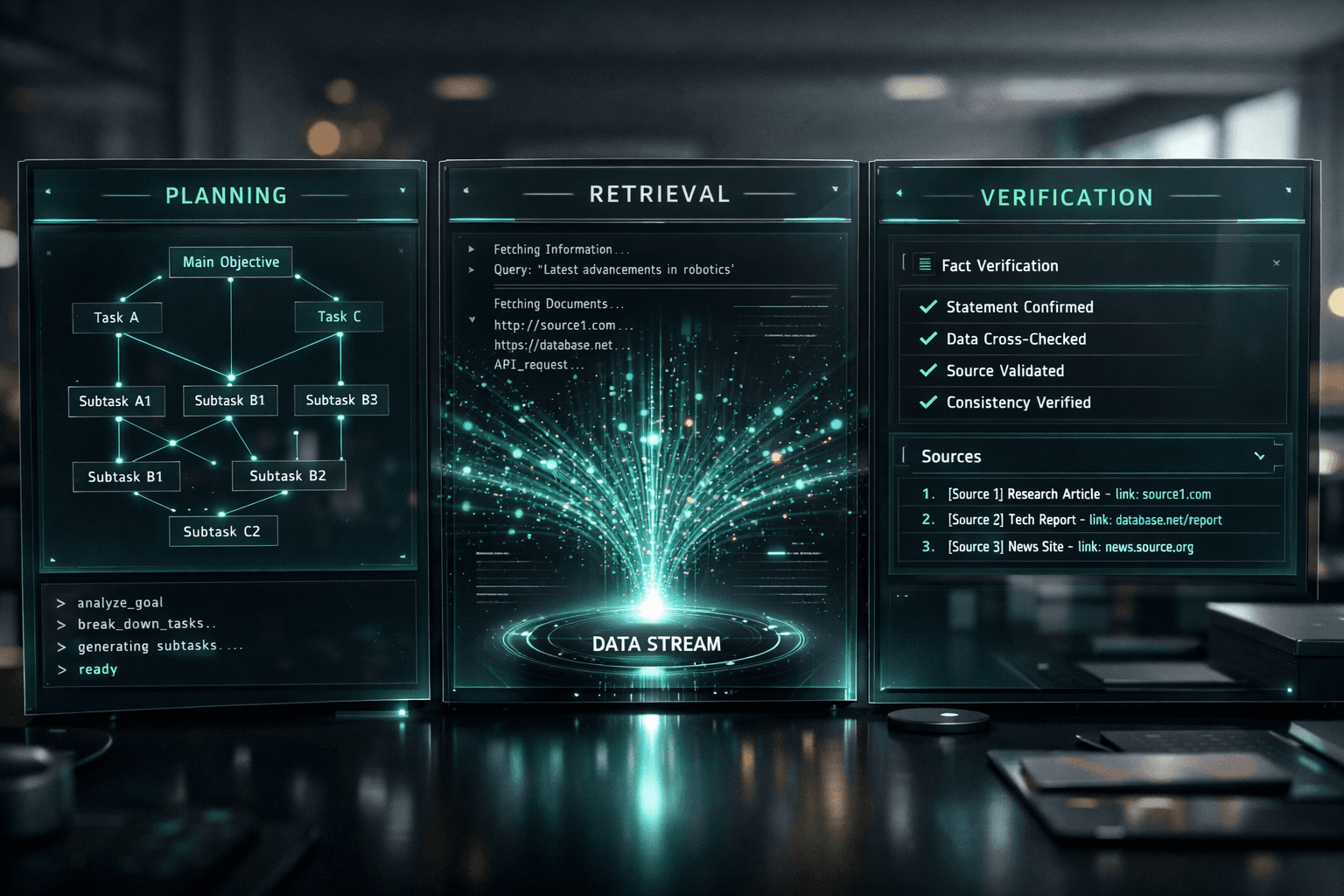
AI Agents for Research and Knowledge Work: Planning, Retrieval, and Verification
Over the past few years, I’ve watched a pattern repeat itself across teams that should know better. Smart engineers wire up a large language model, add a couple of tools, call it an “agent,” and then act surprised when it collapses under real research work. The demos look fine. The internal Slack screenshots look impressive. Then someone asks the system to investigate a messy regulatory question or synthesize conflicting sources, and the whole thing starts hallucinating with confidence. That failure mode isn’t accidental. It comes from misunderstanding what research and knowledge work actually demand from agentic systems.
I design these systems for a living as part of an ai agent development company , and I’ll be blunt: research automation punishes shallow agent design faster than almost any other domain. Through our ai agent development services at Agents Arcade, we've learned that planning, retrieval, and verification are not optional layers—they are the system itself. The moment you accept that, your architecture choices change from chasing the latest model to building a rigorous cognitive framework.
The moment you accept that, your architecture choices change.
Research work is not chat. Knowledge work is not Q&A. When humans research, they plan, fetch, cross-check, and revise. Effective AI agents must do the same, or they will lie convincingly at scale. That’s the uncomfortable truth most teams try to dodge.
The uncomfortable reality of research automation
Most research tasks look simple on the surface. “Summarize recent regulations.” “Compare three vendor architectures.” “Find prior art.” Underneath, each request hides branching paths, ambiguous sources, and missing context. Humans handle this by iterating mentally. Agents need structure.
I’ve seen teams push reactive agents into these workflows because they feel lighter. A prompt, a tool call, maybe a follow-up. That approach collapses once the task spans multiple decisions. Reactive agents chase the last token. They don’t hold intent. They don’t know when to stop searching. They don’t know when evidence conflicts.
Research automation demands deliberate planning, not improvisation. This is where serious agentic systems diverge from toy setups. Once teams internalize this, they usually rediscover first principles and land on architectures that look suspiciously like classical systems design, just with probabilistic components in the loop.
That realization tends to unlock deeper thinking about agentic system architecture, because the problem stops being “Which model should we use?” and becomes “Which cognitive responsibilities belong where?”
Why planning sits at the center of agentic research systems
I don’t trust an agent that can’t explain what it plans to do next. That instinct comes from years of watching silent systems fail in production. Planning exposes intent. Intent exposes mistakes early.
In research contexts, planning is not a luxury layer. It’s the mechanism that turns a vague request into executable structure. Without it, the agent reacts to surface-level cues and misses the deeper objective.

How AI agents plan complex research tasks
Complex research tasks force an agent to decompose goals, sequence actions, and revisit assumptions. Effective planning agents treat research as a stateful process, not a single prompt. They maintain an explicit representation of the task, often as a scratchpad or structured plan, and update it as evidence arrives.
In practice, this means the agent writes down intermediate goals: identify authoritative sources, retrieve primary documents, resolve contradictions, and synthesize conclusions. The plan doesn’t need to be elegant. It needs to be visible and revisable. When teams hide planning inside the model’s latent space, they lose control. When they externalize it, they gain leverage.
I’ve seen LangChain-based planners work reasonably well for bounded research tasks, especially when paired with strict tool schemas. LlamaIndex shines when planning intertwines tightly with document structures and indices. The framework choice matters less than the discipline. Planning agents outperform reactive agents because they commit to a path, even if that path later changes.
This distinction mirrors the deeper planning vs reacting tradeoffs that most teams underestimate until they hit scale. Research agents need foresight, not reflexes.
Retrieval is not search, and treating it as such breaks systems
Teams often talk about retrieval as if it’s a solved problem. “We added a vector database.” “We built a RAG pipeline.” Then they wonder why the agent cites irrelevant passages or misses obvious sources.
Retrieval in knowledge work isn’t about similarity alone. It’s about relevance under intent.
Retrieval strategies for AI agents in knowledge work
Strong retrieval strategies start with intent-aware queries. A research agent should not embed the user’s question once and hope for the best. It should reformulate queries as its understanding evolves. Early retrieval casts a wide net. Later retrieval narrows aggressively. Humans do this instinctively. Agents need explicit loops.
Vector databases play a role, but they are not the system. Embeddings help cluster information, not judge authority. Research agents must mix retrieval modes: vector search for semantic breadth, keyword or metadata filters for precision, and tool calls for external validation. I’ve seen hybrid pipelines outperform pure vector approaches every time in real-world research tasks.
Memory architecture also matters more than most people admit. Short-term memory tracks the current hypothesis. Long-term memory stores resolved facts. Vector memory bridges the two by anchoring context. When teams blur these boundaries, agents repeat work or contradict themselves. Clear vector memory design prevents that decay.
RAG pipelines succeed in research only when retrieval adapts to the agent’s plan. Static retrieval pipelines produce static mistakes.
A necessary digression on tools, because teams misuse them
Let me step sideways for a moment, because tool calling deserves blunt treatment. I’ve reviewed systems where every action routes through a tool because it “feels agentic.” That impulse kills reliability.
Tools should extend capability, not replace reasoning. Research agents need tools for search, document access, citation extraction, and sometimes computation. They don’t need tools for every sentence. When teams overload tool calling, latency spikes, costs balloon, and failure modes multiply.
The real mistake lies in delegating judgment to tools. Tools return data. Agents decide what that data means. When you invert that relationship, the system turns brittle.
I’ve watched teams recover quickly once they cut tool usage by half and forced the agent to reason explicitly about when retrieval actually adds value. That restraint makes the system calmer, cheaper, and easier to debug.
Now back to the core argument.
Verification separates research agents from confident liars
Most hallucination mitigation advice stays superficial. “Lower the temperature.” “Add more documents.” None of that solves the core issue. Research agents hallucinate because they don’t verify.
Verification is not an optional post-processing step. It’s an active phase in the research loop.
Verifying AI agent outputs in research workflows
Verification starts with adversarial self-questioning. After synthesis, the agent must ask: what claims rely on weak evidence, which sources disagree, and what assumptions remain untested. This requires structured evaluation, not vibes.
In production systems, I push for explicit verification passes. The agent re-reads its own output, cross-checks cited sources, and flags uncertainty. Evaluation harnesses automate parts of this, especially when testing RAG pipelines against known answers. Without this discipline, teams ship confident nonsense.
Frameworks help, but culture matters more. LangChain evaluators and LlamaIndex response synthesizers can enforce checks, but only if the team respects them. Verification slows systems down slightly. That slowdown buys trust.
This is where RAG evaluation discipline stops being theoretical and starts saving reputations.
Memory, context, and why agents forget what matters
Research agents fail quietly when memory decays. They repeat searches. They contradict earlier conclusions. They cite outdated context. Humans notice this instantly. Machines don’t unless designed to.
Effective memory architecture treats context as a resource, not a dump. Short-term memory captures the active research thread. Long-term memory persists validated knowledge. Vector memory links related concepts without overwhelming the agent.
When teams let everything bleed into a single context window, performance degrades invisibly. When they segment memory intentionally, agents behave more like careful researchers and less like distracted interns.
Opinionated architecture choices that actually work
I’ll be direct. For research automation, I favor planning-first agents with constrained tools, hybrid retrieval, and explicit verification loops. Reactive agents belong in chat and lightweight automation. Research demands more respect.
I don’t chase the largest model by default. Smaller models with tighter plans outperform larger ones flailing without structure. I don’t trust black-box “autonomous” systems. Autonomy without observability is negligence.
Most importantly, I design agents assuming they will be wrong. Verification, memory boundaries, and evaluation harnesses exist to catch those errors before users do.
Teams that embrace this mindset stop arguing about prompts and start building systems that age well.
Closing perspective from the field
After a decade in distributed systems and the last stretch deep in agentic design, I’ve learned one lesson that keeps repeating: research exposes architectural lies. You can fake intelligence in conversation. You can’t fake rigor in knowledge work.
AI agents succeed in research when they plan deliberately, retrieve thoughtfully, and verify relentlessly. Everything else is decoration.
If you’d benefit from a calm, experienced review of what you’re dealing with, let’s talk. Agents Arcade offers a free consultation.
Majid Sheikh is the CTO and Agentic AI Developer at Agents Arcade, specializing in agentic AI, RAG, FastAPI, and cloud-native DevOps systems.