
How to evaluate LLM responses properly (RAG evaluation)
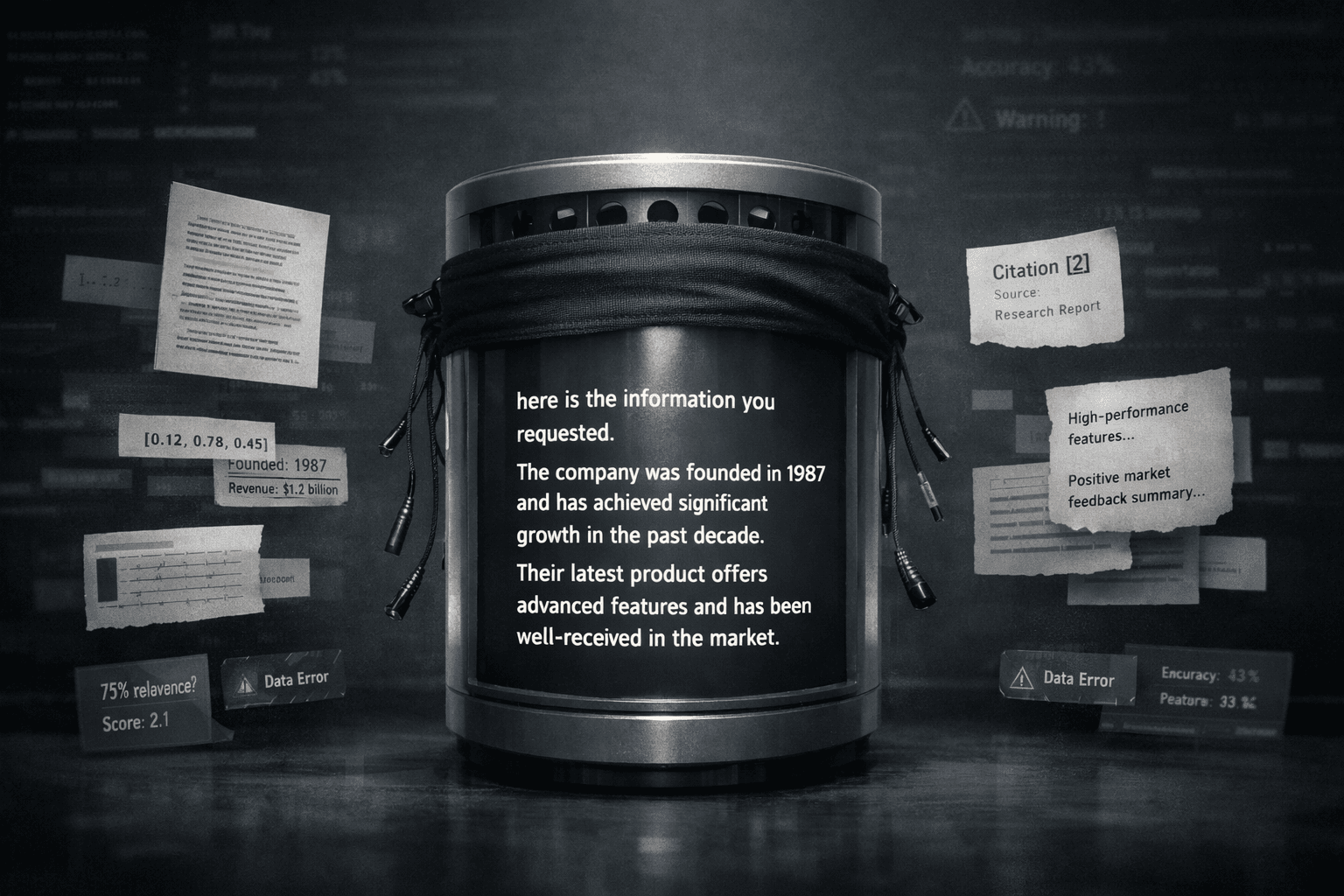
Most RAG systems in production are blind. Not “a little fuzzy,” not “needs tuning,” but genuinely blind. They generate answers that sound plausible, cite the right-looking chunks, and pass every demo you throw at them. And yet, the moment they’re exposed to real users, regulatory scrutiny, or edge-case queries, they start lying with confidence. The uncomfortable truth is that most teams don’t actually know whether their system is good. They just know it hasn’t been caught yet.
If you’d like a broader foundation on how modern AI agents plan, reason, and orchestrate workflows — including how they integrate retrieval and tool use — check out our practical guide to AI agents .
I’ve been building and breaking NLP systems long enough to recognize this pattern. We ship retrieval, we add a reranker, we tweak prompts, and we eyeball a few responses. Maybe someone throws together a spreadsheet with “good” and “bad” labels. Then leadership asks if we’re ready to scale. Everyone nods. No one can answer the only question that matters: how do you know your RAG system is producing high-quality, faithful, and economically viable answers at scale?
Here’s the thing. Evaluation is not a garnish on top of RAG. It is the system. If you don’t treat evaluation as a first-class engineering problem, you are flying blind by design.
Why traditional NLP metrics fail for RAG
This is where many experienced ML folks get uncomfortable, because the tools we relied on for years simply don’t work anymore. BLEU, ROUGE, METEOR, exact match—pick your favorite museum piece. These metrics assume a static input-output mapping with a known ground truth. RAG violates that assumption at every layer.
In a RAG pipeline, the model’s answer is a function of retrieval quality, chunking strategy, embedding relevance, prompt framing, and generative behavior. Two answers can be semantically correct, grounded in different retrieved contexts, and yet look nothing alike lexically. Traditional NLP metrics punish that diversity. Worse, they reward parroting. A model that copies phrasing from a reference answer scores well even if it hallucinates facts between the lines.
I’ve seen teams celebrate improved ROUGE scores while their system confidently answered questions using outdated policy documents. The metric said “good.” Reality said “lawsuit.”
RAG evaluation requires judging properties like Faithfulness to retrieved context, Context Recall, and Answer Relevancy. These are semantic, not syntactic. They live in the messy space where meaning, grounding, and intent collide. Pretending otherwise is professional negligence.
The illusion of “ground truth” in enterprise RAG
Another trap is the obsession with ground truth generation. Everyone wants a golden dataset. I get it. Golden datasets feel safe. They feel scientific. The problem is that in most enterprise settings, the “truth” is fragmented across PDFs, wikis, emails, and tribal knowledge. When you force a single canonical answer, you are often encoding bias or staleness into your evaluation.
What actually matters is whether the answer is supported by the retrieved context and whether that context is relevant to the query. A RAG system that answers, “According to the 2023 compliance manual, X is allowed,” is correct even if a human reference answer phrases it differently. Conversely, an answer that sounds right but cites irrelevant chunks is dangerous, no matter how fluent it is.
This is why evaluation must explicitly separate retrieval evaluation from generation evaluation. Vector embedding relevance, chunk coverage, and recall must be measured independently from the language model’s prose. If your retriever fails silently, no amount of prompt engineering will save you.
LLM response quality is not about eloquence
Let’s talk about LLM response quality, because this phrase gets abused constantly. Quality is not eloquence. It’s not verbosity. It’s not “sounds smart.” In RAG systems, quality is about alignment between question, retrieved evidence, and generated answer.
A high-quality response is relevant, faithful, complete enough for the user’s intent, and constrained by the provided context. It may even say “I don’t know” when retrieval fails. That answer often scores poorly in naive human reviews, which tells you more about reviewer incentives than model performance.
If your evaluation pipeline doesn’t penalize unsupported claims, you are explicitly rewarding hallucination. And yes, I mean that literally. Models optimize for what you measure. If hallucinations don’t hurt their score, they will proliferate.
Automated hallucination detection is table stakes now
At this point, automated hallucination detection is not a “nice to have.” It is table stakes. Relying on sporadic human review in a system that generates thousands or millions of responses is fantasy.
The hard part is defining hallucination correctly. In RAG, hallucination is not “saying something false in the abstract.” It is generating statements that are not supported by the retrieved context. That distinction matters. A statement can be factually true and still be a hallucination if it is not grounded in the provided sources.
This is where LLM-based evaluators shine, despite all the skepticism. You can prompt an evaluator model to check whether each claim in the answer is entailed by the retrieved context. When done carefully, this approach scales. Is it perfect? No. Is it better than vibes-based review? By orders of magnitude.
The key is to treat hallucination detection as a probabilistic signal, not an oracle. You track trends. You compare variants. You don’t pretend you’ve solved truth itself.
Implementing the Ragas and TruLens frameworks
If you are serious about RAG evaluation and still rolling your own ad-hoc scripts, you are wasting time. Frameworks like Ragas and TruLens exist for a reason. They encode hard-won lessons about what to measure and how to measure it.
Ragas focuses heavily on metrics like Context Recall, Faithfulness, and Answer Relevancy. It forces you to confront the relationship between retrieved documents and generated answers. TruLens, on the other hand, provides a broader observability layer, integrating evaluation into the application lifecycle with feedback functions and traces.
Here’s my opinion, and it’s not a diplomatic one. Use these frameworks, but don’t worship them. Out of the box, they will not reflect your domain, your risk tolerance, or your users. You must customize the evaluation prompts, define what “relevant” means in your context, and decide how strict faithfulness should be.
I’ve seen teams blindly trust default thresholds and then wonder why their system passed evaluation but failed in production. Frameworks are scaffolding, not substitutes for thinking.
The economics of LLM-as-a-Judge
Now we get to the part everyone complains about. Cost. Latency. “Do we really need another LLM call just to evaluate an answer?” Short answer: yes. Longer answer: you can’t afford not to.
LLM-as-a-Judge is currently the only scalable path forward for evaluating semantic properties like faithfulness and relevancy. Human-in-the-loop review does not scale. Rule-based checks collapse under linguistic variation. Embedding similarity alone cannot detect unsupported claims.
The economics are not as bad as people assume. You don’t need to evaluate every single response in real time. You can sample. You can batch. You can run evaluations asynchronously. What matters is that you have continuous signals about system behavior.
Latency trade-offs are real, but they are manageable. Evaluation does not have to block user responses. In many systems, it shouldn’t. You log, you score, you analyze, and you feed the insights back into retrieval tuning, prompt updates, and dataset curation.
To be honest, if the cost of evaluation breaks your business model, your business model was already broken.
Human-in-the-loop is a scalpel, not a hammer
This is where I’ll digress briefly, because HITL is often misunderstood. Human-in-the-loop is not about reviewing everything. It is about reviewing the right things. Edge cases. Low-confidence evaluations. High-risk queries. Regulatory-sensitive outputs.
Your automated pipeline should surface these cases. Humans then provide high-quality judgments that update golden datasets and recalibrate evaluator prompts. This feedback loop is where real improvement happens.
If humans are randomly sampling outputs without context, they are just another noisy metric. Worse, they are expensive noise.
Prompt injection testing belongs in evaluation
One more uncomfortable truth. If you are not evaluating prompt injection resilience, you are not evaluating your system. Period.
RAG systems are especially vulnerable because they blend external context with user input. Evaluation must include adversarial queries that attempt to override instructions, extract system prompts, or manipulate retrieval behavior. These tests should be automated and repeatable, not one-off red team exercises that everyone forgets after the slide deck.
I’ve seen systems with excellent average scores fail catastrophically under trivial injection attempts. That failure mode is entirely predictable if you bother to measure it.
Golden datasets are living artifacts
Remember those golden datasets everyone loves? They should not be static. They should evolve as your system evolves. New documents. New user intents. New failure modes.
Evaluation pipelines should make it easy to add new test cases when something breaks. If a user reports a bad answer, that query should become part of your evaluation suite within days, not quarters. This is how you prevent regressions and institutional amnesia.
A golden dataset that never changes is not golden. It’s fossilized.
Bringing it all together in production
A production-grade RAG evaluation pipeline is not glamorous. It is plumbing. It is dashboards showing Faithfulness trends over time. It is alerts when Context Recall drops after a retriever update. It is cost curves showing how evaluation sampling affects spend.
Most importantly, it is humility encoded as code. The humility to assume your system can fail, and the discipline to measure how and when it does.
If this sounds heavy, that’s because it is. But the alternative is worse. Blind systems fail quietly until they don’t. And when they don’t, the damage is public, expensive, and sometimes irreversible.
RAG is not magic. It is an engineering system. And engineering systems live or die by how well you evaluate them.
If you’re done wrestling with this yourself, let’s talk. Visit Agents Arcade for a consultation.
Majid Sheikh is the CTO and Agentic AI Developer at Agents Arcade, specializing in agentic AI, RAG, FastAPI, and cloud-native DevOps systems.