
Planning vs Reacting: How AI Agents Decide What to Do Next
If you’ve built more than one production agent, you’ve already felt the tension. On one side, you want agents that pause, reason, decompose, and commit to a plan. On the other, you want systems that respond immediately to changing inputs without getting stuck in their own head. Most teams try to blend the two and end up with something brittle, opaque, and hard to debug. That outcome isn’t accidental. It’s the result of not being explicit about how decisions are made, when they’re made, and what information is allowed to influence them.
How AI agents plan tasks
Planning in AI agents is not about generating a clever to-do list. It’s about establishing a temporary contract between the agent and the environment. When an agent plans, it is asserting assumptions: that certain tools will behave predictably, that the environment state won’t drift too far, and that the cost of deliberation is justified by the stability it creates.
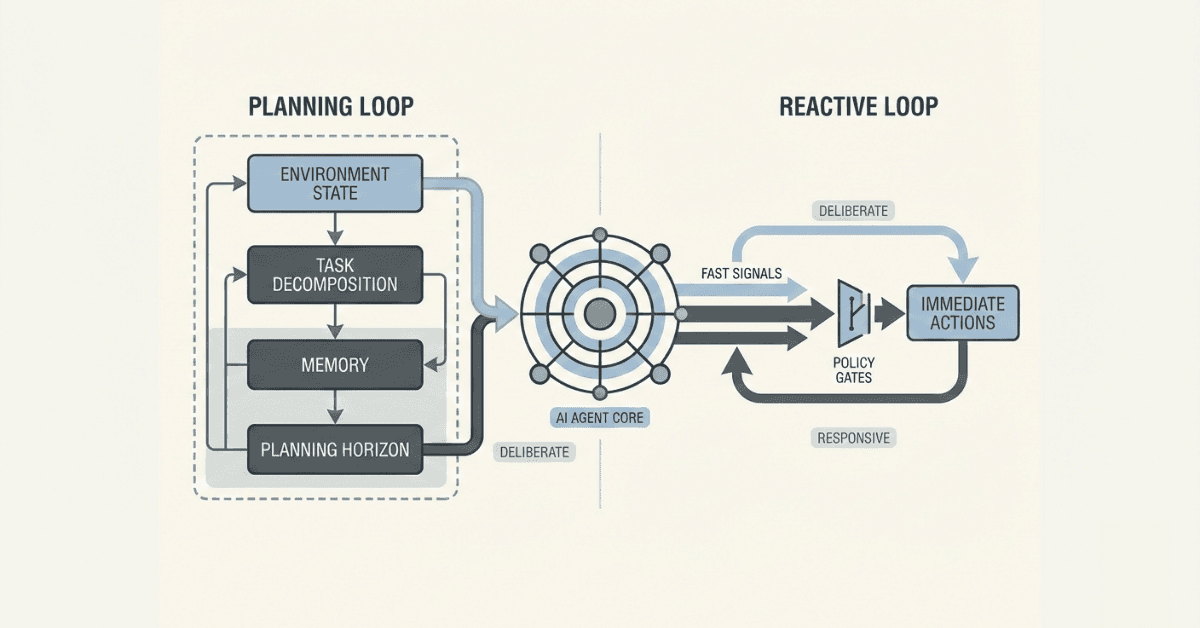
In real systems, planning usually emerges from task decomposition layered on top of a language model. The agent receives a goal, breaks it into subgoals, orders them, and commits to an execution path. That commitment is the key detail most tutorials gloss over. A plan only matters if the agent resists the urge to re-plan every time new information appears. Without that resistance, you don’t have planning; you have verbose reacting.
The planning horizon matters more than the sophistication of the planner. Short-horizon plans are cheap and flexible but offer little leverage. Long-horizon plans amplify small errors and can collapse under environmental noise. Experienced teams tune planning depth based on tool reliability, latency, and reversibility. If a tool call is expensive or irreversible, planning earns its keep. If everything is fast and undoable, planning becomes overhead.
This is where agent memory quietly becomes a liability. Plans stored as natural language are easy to inspect but hard to enforce. The model treats them as suggestions, not constraints. Unless you encode plans into control flow the agent cannot casually override, you’re trusting compliance rather than architecture. That trust does not survive contact with production traffic.
At Agents Arcade, we’ve learned to treat planning artifacts as scaffolding, not gospel. Plans exist to structure early reasoning, not to dictate every step. When teams cling too tightly to plans, agents become fragile. When they abandon planning entirely, agents become chaotic. The discipline lies in deciding what must be planned and what must remain reactive.
Reactive vs deliberative agents
Reactive agents get unfairly dismissed as “dumb,” mostly by people who haven’t shipped them at scale. In practice, reactivity is a survival trait. A reactive agent maps inputs to actions with minimal internal state. It responds to signals, executes policies or heuristics, and moves on. There’s no deep introspection, and that’s the point.
Deliberative agents, by contrast, carry internal models of the world. They reason about future states, simulate outcomes, and select actions based on predicted trajectories. This is intoxicating when it works and exhausting when it doesn’t. Deliberation introduces latency, complexity, and new failure modes. It also introduces the illusion of intelligence, which is often mistaken for reliability.
The mistake I see repeatedly is teams choosing deliberation because it feels more “agentic.” In reality, most production systems benefit from a reactive core with deliberative overlays. The core handles fast feedback loops and obvious decisions. Deliberation is invoked selectively, under controlled conditions, when uncertainty or risk crosses a threshold.
This distinction matters when you compare agentic workflows to traditional chatbots. Chatbots are reactive by default. They wait, respond, and forget. Agents differ not because they plan more, but because they are allowed to act and observe. If you want a clean mental model of that shift, the contrast is laid out clearly in AI Agents vs Chatbots: What’s the Real Difference? , and it’s worth internalizing before you add another reasoning layer that solves the wrong problem.
In practice, reactivity keeps systems alive under stress. Deliberation makes them useful under ambiguity. Mixing the two without explicit boundaries produces agents that hesitate when they should act and act when they should hesitate.
Decision loops in AI agents
Every agent, whether you admit it or not, runs a decision loop. Observe the environment. Update internal state. Decide. Act. Repeat. The stability of that loop determines whether your system converges or oscillates.
The simplest loops are stateless. Input comes in, output goes out. These loops are easy to reason about and hard to extend. Stateful loops introduce memory, which allows adaptation but also creates feedback loops you didn’t design. The moment an agent’s past outputs influence its future decisions, you’ve built a dynamic system. Dynamic systems amplify mistakes.
Most failures I’ve debugged trace back to unbounded loops. The agent keeps reflecting, re-evaluating, or tool-calling because nothing in the control flow tells it to stop. Developers blame the model, then add more prompts, then add more memory, which makes the loop even harder to exit. The fix is almost always architectural. You need explicit termination conditions, cost ceilings, and state checkpoints.
Decision loops also expose the difference between policy and heuristic. Policies are explicit rules enforced by the system. Heuristics are suggestions embedded in prompts. Agents respect policies. They negotiate with heuristics. If your stopping conditions live in natural language, they will be violated under pressure.
This is where tool calling becomes dangerous. Tools extend an agent’s reach into the real world, but they also distort its decision loop. Each tool call creates new environment state, which feeds back into the agent’s context. Without careful gating, agents start optimizing for tool usage instead of outcomes. I’ve seen agents that “solve” tasks by repeatedly querying the same API because nothing in the loop penalized redundancy.
A well-designed loop constrains agency rather than celebrating it. That may sound heretical, but autonomy without control is just entropy with better marketing.
There’s a broader architectural perspective on this that’s explored in depth in agentic system design , and it’s the piece many teams skip while chasing demos.
A necessary digression: why more reasoning often makes agents worse
Let me step sideways for a moment, because this is where otherwise sharp teams go astray. When agents behave unpredictably, the instinctive response is to add more reasoning. More chain-of-thought. More self-reflection. More “thinking.”
In isolation, this feels sensible. In systems, it’s poison. Each added reasoning step increases latency, context size, and the surface area for hallucination. Worse, it convinces teams they’ve solved a control problem with cognition. They haven’t.
I’ve watched agents spiral into self-referential loops because they were instructed to “double-check” their work indefinitely. The system didn’t fail because the model was weak. It failed because nobody decided when thinking should stop. Reasoning is a resource. If you don’t budget it, agents will spend it irresponsibly.
The return from this digression is simple: decision quality improves when constraints are clear, not when reasoning is verbose. Clarity beats cleverness every time.
Planning, reacting, and the environment state
Environment state is the silent partner in every agent decision. Agents don’t act in a vacuum; they act based on what they believe the world looks like right now. That belief is almost always wrong in small but consequential ways.
Planning assumes a relatively stable environment. Reacting assumes volatility. The more dynamic the environment, the less valuable long-range planning becomes. This is why agents operating over live systems, user inputs, or external APIs tend to drift toward reactive patterns over time, even if they started deliberative.
The trick is not to fight that drift but to structure it. Capture environment state explicitly. Version it when possible. Treat observations as snapshots, not truths. When agents plan, anchor those plans to a specific state and invalidate them aggressively when the state changes. Most teams do the opposite: they let stale plans limp along until they fail dramatically.
Agent memory complicates this further. Memory extends the environment backward in time. Without pruning, agents start making decisions based on conditions that no longer exist. I’ve seen agents refuse perfectly valid actions because a prior failure was cached as a global rule. Memory needs decay, just like plans do.
Why hybrid architectures win in practice
Purely deliberative agents look impressive in controlled demos. Purely reactive agents look unimpressive but keep running. In production, hybrids dominate because reality demands it.
A hybrid agent uses planning to set direction and reaction to maintain stability. High-level goals are planned. Low-level actions are reactive. Decision loops are shallow by default and deepen only when necessary. Tool access is gated by policy, not persuasion.
If you want concrete examples of how this plays out beyond theory, the patterns show up clearly in Real-world examples of AI agents automating tasks (research, content creation, support) , where the successful systems are the ones that limit autonomy in the name of reliability.
This hybrid approach also scales better across teams. Planning logic can be reasoned about, reviewed, and tested. Reactive policies can be tuned independently. When something breaks, you know whether the failure was strategic or tactical. That alone saves weeks of debugging.
Control flow is the real differentiator
After years of building these systems, I’m convinced the real differentiator isn’t the model, the framework, or even the tools. It’s control flow. Who decides what happens next, and under what conditions.
If the model decides everything, you don’t have an architecture. You have a hope. If the system decides everything, you don’t have an agent. You have a script. The sweet spot is a negotiated boundary where the model proposes and the system disposes.
This is why discussions about autonomous AI agents often miss the mark. Autonomy is not binary. It’s scoped. The most effective agents I’ve seen are constrained in boring, unglamorous ways that never make it into blog posts. They are allowed to act, but only inside guardrails that were designed by people who had already been burned.
If you’re serious about agentic workflows, start treating decision-making as a design surface. Decide when planning is allowed, when reaction is mandatory, and when the agent must defer. Encode those decisions into control flow, not prose. Everything else is decoration.
If you’d benefit from a calm, experienced review of what you’re dealing with, let’s talk. Agents Arcade offers a free consultation.
Majid Sheikh is the CTO and Agentic AI Developer at Agents Arcade, specializing in agentic AI, RAG, FastAPI, and cloud-native DevOps systems.