
AI Agents vs Chatbots: What’s the Real Difference?
For a long time, teams were happy if a chatbot didn’t embarrass them in front of customers. If it answered a few FAQs, deflected some tickets, and didn’t hallucinate refunds, it was considered a win. Somewhere in the last eighteen months, that bar quietly moved. Products started shipping with “agents” instead of “bots,” demos began showing systems booking meetings, updating CRMs, triggering workflows, and suddenly everyone pretended this was just a natural evolution. It wasn’t. It was a break. Most teams still haven’t named it properly, which is why so many production systems feel awkwardly overengineered—or dangerously underpowered.
Here’s the thing: calling everything a chatbot is no longer harmless shorthand. It’s actively confusing architectural decisions that matter in production.
A lot of that confusion comes from teams using the term agent without agreeing on what they mean by it. In practice, there’s a real gap between how businesses talk about AI agents and how they’re actually built and operated by engineering teams. I break that distinction down in What Is an AI Agent? (Business vs Technical View) , because if you don’t align on the definition early, everything downstream—architecture, tooling, expectations—starts on the wrong foot.
I’ve built conversational systems back when intent classification was the hard part and retrieval was a luxury. I’ve also spent the last few years cleaning up after teams who slapped an LLM behind a chat UI and expected it to behave like a reliable system. The difference between chatbots and AI agents isn’t cosmetic, and it’s not about how clever the responses sound. It’s about whether the system can act, decide, recover, and keep state in a world that doesn’t politely wait for the next user message.
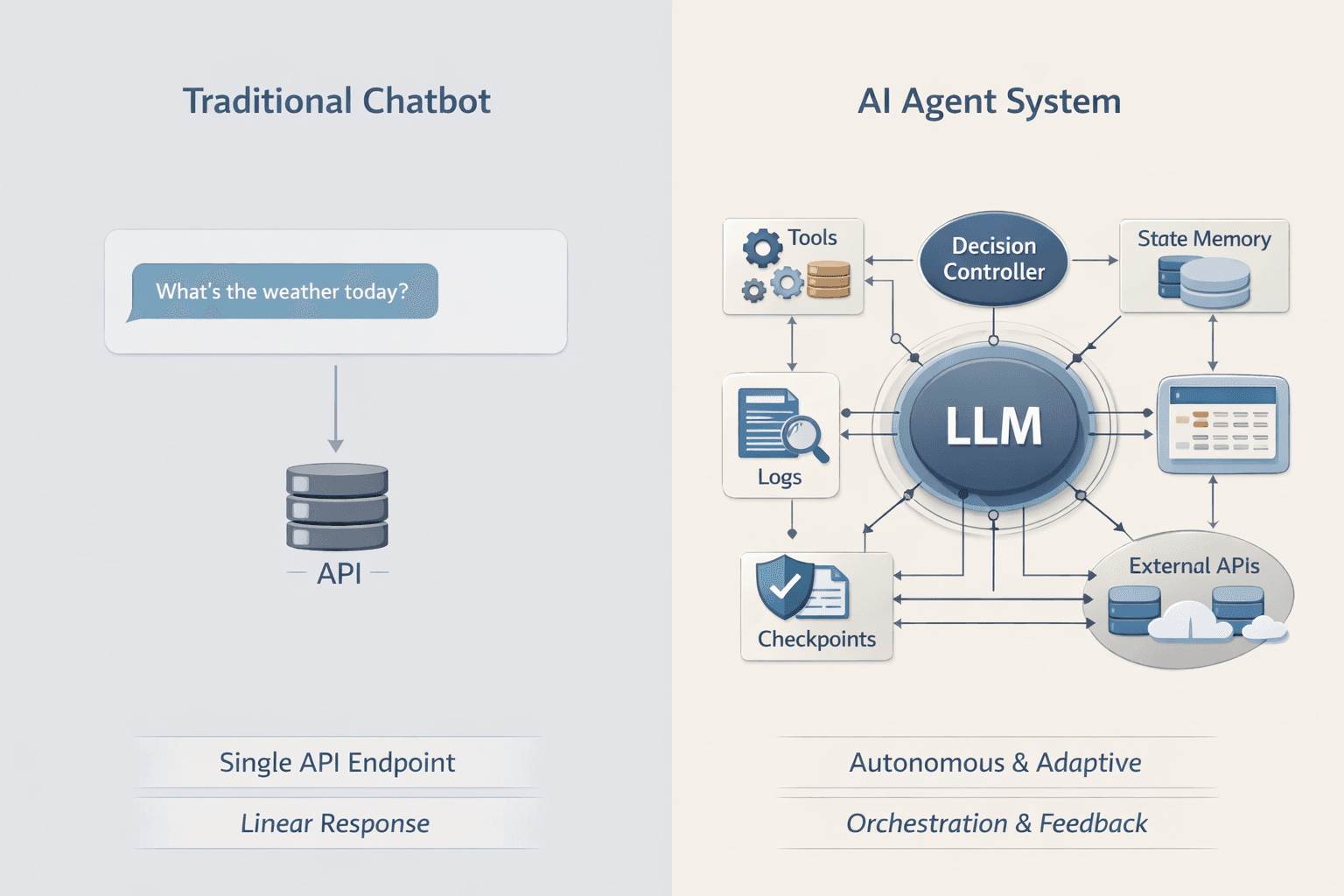
Traditional chatbots are reactive. They wake up when spoken to, generate a response, and go back to sleep. Even the better ones, with RAG pipelines and function calling bolted on, still operate inside a tight conversational loop. An agentic AI system doesn’t wait to be prompted in the same way. It reasons over goals, chooses actions, invokes tools, observes outcomes, and adjusts. That difference changes everything from how you design APIs to how you think about failure modes.
Most marketing pages blur this line because it’s convenient. In production, that blur is expensive.
Let’s talk about where the real boundary sits, and why pretending it doesn’t exist keeps breaking systems in subtle, painful ways.
AI agents vs chatbots for business automation
Business automation is where the illusion usually collapses. A chatbot can answer questions about an order. It can even look up the order status if you wire it into a backend. But the moment you ask it to resolve the issue end to end—verify eligibility, trigger a refund, notify accounting, update the CRM, and follow up if something fails—you’re no longer in chatbot territory.
A chatbot is fundamentally scoped around a single conversational turn, even if that turn is augmented with retrieval or a function call. It reacts to input and produces output. You can chain turns together, sure, but the system itself has no durable sense of progress. It doesn’t know whether it’s halfway through a task or stuck in a loop unless you hard-code that awareness around it.
AI agents are built around goals, not prompts. In a business automation context, that distinction is everything. The agent is given an objective, constraints, and access to tools. It plans, executes, checks results, and continues until the goal is satisfied or deemed impossible. Conversation becomes just one interface, not the core abstraction.
This is why chatbot-based automations feel brittle at scale. You end up encoding business logic into prompt templates and hoping the model behaves. When something goes wrong, you’re debugging text. With agents, the logic lives in orchestration layers, state machines, and tool contracts. The model reasons, but the system decides.
That shift is uncomfortable for teams who want AI to feel “simple.” Automation isn’t simple. Pretending it is just pushes complexity into places you can’t control.
How AI agents make decisions using tools
There’s a persistent misunderstanding that agents are just chatbots that can call APIs. Tool calling alone doesn’t make a system agentic. Decision-making does.
In a real agentic system, the LLM is part of a loop. It observes the current state, reasons about what to do next, selects a tool, executes it, observes the result, updates state, and repeats. That loop is explicit. State management is not an afterthought; it’s the backbone. You track what’s been attempted, what succeeded, what failed, and what still needs to happen.
This is where function calling and LLM orchestration stop being buzzwords and start being infrastructure. The agent doesn’t just know that a tool exists; it understands when to use it, in what order, and under which conditions. If a tool returns an unexpected response, the agent can decide whether to retry, choose an alternative path, or escalate.
Chatbots, by contrast, treat tools as extensions of conversation. A user asks something, the model decides to call a function, and the result is turned back into text. There’s no persistent decision loop unless you build one externally, and most teams don’t. They rely on the model to “figure it out,” which works right up until it doesn’t.
In production AI systems, decision-making has to be inspectable. You need to know why a system did what it did. Agent architectures allow for that because decisions are structured, logged, and tied to state transitions. Chatbot architectures hide decisions inside generated text, which is a nightmare when something breaks at 3 a.m.
This isn’t academic purity. It’s the difference between a system you can operate and one you just hope behaves.
At this point, it’s worth a short digression, because I see the same mistake repeated across teams of very smart engineers.
For years, backend systems were built around explicit workflows. You could draw them, version them, and reason about them. Then microservices happened, and everyone pretended the workflows would “emerge” from loosely coupled APIs. They did, but only after a lot of pain, tracing, and retrofitted observability. We’re doing the same thing again with LLMs, assuming intelligence will replace structure.
It won’t. Intelligence without structure just fails in more creative ways.
Agentic systems are, in many ways, a return to explicit workflows—just with a reasoning component that can adapt paths dynamically. That’s not regression. It’s maturity.
When a chatbot is not enough
There’s a specific moment in most AI projects when a chatbot stops being sufficient. It usually shows up as a growing prompt file and a creeping sense that you’re duct-taping logic into language.
If your system needs to remember what it did five steps ago, handle partial failures, or coordinate across multiple systems, you’re already past the chatbot line. If it needs to operate without a user constantly nudging it forward, you crossed that line earlier than you think.
Chatbots excel at narrow, conversational tasks. Support triage. Simple Q&A. Guided interactions where the user remains in control. The problem is that teams keep stretching them into roles they were never designed for. They add more context, more retrieval, more instructions, and then wonder why the model behaves unpredictably.
AI agents are designed for autonomy, but autonomy comes with responsibility. You need guardrails. You need observability. You need clear tool contracts and failure handling. Most importantly, you need to accept that agents are systems, not features.
This is where “agentic AI” becomes less about models and more about engineering discipline. You’re orchestrating reasoning across time, not just generating text. You’re building decision-making systems, not chat experiences.
When teams get this right, the payoff is significant. Agents can handle tasks end to end. They reduce human-in-the-loop overhead. They operate continuously, not just conversationally. When teams get it wrong, they ship something that looks impressive in a demo and collapses under real-world load.
The uncomfortable truth is that many organizations don’t actually need agents. They need better-scoped chatbots. The danger comes from not knowing which one you’re building.
In production environments, clarity beats ambition. If you want a conversational interface, build a chatbot and keep it honest. If you want a system that acts, decides, and adapts, commit to agent architecture and accept the complexity that comes with it.
Trying to sit in the middle is how you end up with fragile systems that no one fully understands.
If you’ve reached this point and realized you’re not just “adding AI” but designing an agentic system, the next set of problems is architectural, not conversational. Tool orchestration, state management, guardrails, evaluation, and long-term operability matter more than prompt cleverness. That’s where most teams stall. I’ve laid out a hands-on breakdown of how to design, deploy, and scale these systems in production in practical guide to building and scaling AI agents —from choosing the right agent model to avoiding the failure patterns that quietly kill agent projects.
The real difference between AI agents and chatbots isn’t intelligence. It’s intent. Chatbots exist to respond. Agents exist to accomplish. Once you internalize that, architectural decisions get easier, even if they get heavier.
And yes, heavier systems require more thought, more testing, and more operational rigor. But they also unlock capabilities that chatbots simply can’t reach without breaking under their own cleverness.
If you want a smoother path forward, get support from Agents Arcade today.
Majid Sheikh is the CTO and Agentic AI Developer at Agents Arcade, specializing in agentic AI, RAG, FastAPI, and cloud-native DevOps systems.