
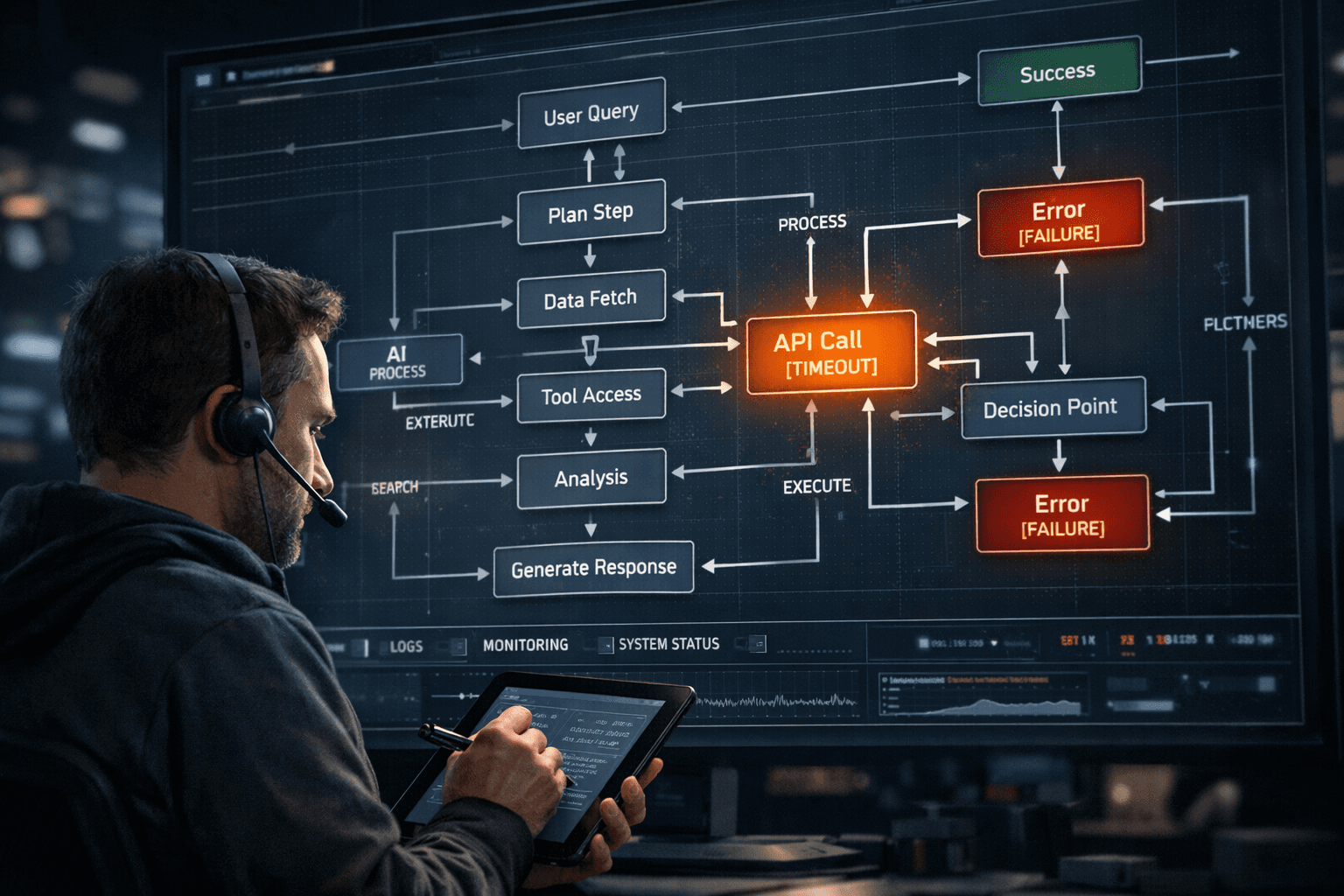
Observability for AI Agents: Logs, Traces, and Metrics That Actually Matter
After a few years of watching agent systems move from clever demos to production workloads, a pattern becomes impossible to ignore. The teams that struggle aren’t the ones with weaker models or worse prompts. They’re the ones flying blind. Their agents fail quietly, degrade slowly, and behave “oddly” long before anything hard-crashes. By the time someone opens a ticket, the only artifact left is a vague user complaint and a stack of unhelpful logs saying everything was “successful.”
That’s not a tooling problem. That’s an observability failure.
Most AI agent observability efforts today are still cargo-culted from web services. Request in, response out, measure latency, count errors, ship logs to somewhere expensive. That model collapses the moment you introduce multi-step reasoning, tool calls, retries, state transitions, and non-deterministic outputs. Agent systems don’t fail like APIs. They unravel. And if you don’t instrument for that reality, no dashboard will save you.
Why traditional observability breaks down for agentic systems
Classic observability assumes a stable execution path. An HTTP request hits a service, flows through predictable layers, and returns a response. Even in distributed systems, the shape is mostly known. AI agents violate that assumption immediately. They branch. They loop. They call tools conditionally. They revise plans mid-flight. Two executions that look identical at the API boundary may diverge entirely internally.
This is why so many teams insist their agent “worked in staging” but “acts weird in prod.” What they really mean is they never saw what it was actually doing. Without visibility into reasoning steps, tool invocations, and state transitions, you’re left inferring behavior from side effects. That’s not observability. That’s guesswork.
If you’ve already internalized that agent systems are not just chatbots with a nicer name, the broader architectural implications should be familiar. In fact, this is one of the moments where teams often go back and re-read deeper material like AI Agents: A Practical Guide for Building, Deploying, and Scaling Agentic Systems, because observability pressure tends to expose every architectural shortcut you made earlier.
What to log in AI agent systems
Most teams log far too much and almost none of the right things. They dump raw prompts, full model responses, and verbose debug output, then drown in noise while missing the signal. Logging for agents is not about exhaustiveness. It’s about intent and outcome.
The first thing worth logging is agent intent at each decision point. Not the full chain-of-thought, which you shouldn’t be persisting anyway, but the structured decision boundary. Why did the agent choose to call a tool? Why did it decide to retry? Why did it abandon a path? These are compact, semantic events that survive aggregation and actually help during production debugging.
The second critical log category is tool-call outcomes. Tool-call failures are not binary errors. A tool can succeed technically and still fail operationally by returning stale, partial, or misleading data. Logging input parameters, latency, and summarized outputs gives you a fighting chance of correlating downstream agent behavior with upstream tool quality.
State changes matter more than messages. Agent state transitions tell you when an agent moved from planning to execution, from execution to evaluation, or from recovery to escalation. These transitions are where subtle bugs hide. If you don’t log them explicitly, you’ll never reconstruct the sequence after the fact.
Finally, log user-visible consequences. Did the agent respond confidently with incorrect information? Did it stall? Did it escalate to a human? Observability that ignores user impact is self-indulgent. Production systems exist to serve someone, not to satisfy internal dashboards.
Notice what’s missing here: full prompt dumps and token-by-token traces. Those belong in controlled debugging environments, not your primary production logs. Token usage tracking deserves its own treatment, but logs are the wrong place to brute-force it.
tracing multi-step agent workflows
If logs tell you what happened, traces tell you how it unfolded. Distributed tracing is not optional for agent systems, even if you’re running everything inside a single service. The moment an agent executes more than one meaningful step, you need trace context.
Tracing multi-step agent workflows starts by redefining what a “request” is. In agentic systems, the unit of work is often an episode, not an HTTP call. An episode might span multiple model invocations, tool calls, retries, and state transitions. Your trace should reflect that lifespan, even if it crosses process boundaries.
OpenTelemetry is currently the least painful way to do this, but only if you resist the temptation to auto-instrument everything and call it done. Agent traces need custom spans that represent semantic steps: planning, tool selection, execution, evaluation, and recovery. These spans give you structure. Without them, you’re staring at a flat timeline of “LLM call” events that tell you nothing.
Tracing also exposes latency budgets in a way logs never will. When an agent blows its response-time SLA, the culprit is rarely a single slow model call. It’s death by a thousand cuts. Slightly slow tool calls, unnecessary replanning, redundant retries. A trace makes that visible in seconds.
Teams that invest here tend to converge on similar designs to those described in Common AI Agent Architecture Patterns . That’s not coincidence. Once you start tracing agent workflows, architectural clarity becomes less theoretical and more urgent.
Metrics that matter for AI agents
Metrics are where most teams fool themselves. They pick what’s easy to count and call it insight. Request counts, average latency, error rates. Those metrics describe infrastructure health, not agent effectiveness.
The first metric category that actually matters is outcome quality proxies. You can’t directly measure correctness in most systems, but you can measure signals that correlate with it. Excessive retries, frequent tool-call loops, repeated clarifications requested from users. These patterns usually precede visible failures.
Token usage tracking belongs here as well, but not as a vanity graph. Tokens are a cost surface and a latency amplifier. Sudden increases often indicate prompt bloat, runaway context accumulation, or silent feedback loops. If you’re not correlating token usage with specific agent behaviors, you’re missing the point.
Latency metrics need to be decomposed by phase. End-to-end latency hides more than it reveals. Planning latency, tool latency, inference latency, and recovery latency tell very different stories. Agents that feel “slow” to users are often spending time thinking unnecessarily, not waiting on models.
Failure metrics should emphasize tool-call failures and partial failures, not just exceptions. An agent that returns a confident but wrong answer is operationally worse than one that throws an error. Inference monitoring has to account for that asymmetry.
This is also where scaling strategies surface unexpectedly. Metrics often reveal that horizontal scaling doesn’t fix the bottleneck you thought it would. In agent systems, scaling the backend without addressing coordination overhead can actually worsen tail latency, a reality explored in Horizontal Scaling Strategies for AI Agent Backends.
The uncomfortable truth about chain-of-thought and observability
Here’s the digression most teams resist, but it matters. There is a persistent belief that deeper observability requires capturing more of the model’s internal reasoning. That belief is wrong, and it’s dangerous.
Persisting chain-of-thought is a liability. It increases storage costs, complicates compliance, and creates a false sense of understanding. Most of the time, it doesn’t explain failures anyway. What explains failures are decisions and transitions, not raw text.
The better approach is to design agents that externalize decisions in structured form. When an agent chooses a tool, log the choice and the reason category, not the internal monologue. When it retries, log the trigger condition. This gives you observability without turning your system into a forensic nightmare.
The teams that get this right stop treating observability as an afterthought and start treating it as a design constraint. Once you do that, a lot of downstream complexity evaporates.
And yes, this means pushing back when someone insists on “just logging everything for now.” That path leads to expensive silence, not insight.
Feedback loops, drift, and slow-motion failures
One of the nastiest classes of agent failures doesn’t show up as errors at all. It shows up as gradual degradation. Responses get longer. Costs creep up. Latency stretches. User satisfaction erodes quietly.
This is where observability earns its keep. Feedback loops, especially implicit ones where agent outputs influence future inputs, can amplify small issues into systemic problems. Without metrics that track behavior over time, you won’t notice until the system feels “off,” and by then you’re debugging history.
Drift monitoring is not just for models. Agent behavior drifts when tools change, data distributions shift, or prompts accrete cruft. Observability that compares current behavior against historical baselines is the only practical defense.
Production debugging in these scenarios is less about fixing a bug and more about arresting entropy. You can’t do that blind.
Designing observability as part of the agent, not around it
The most reliable agent systems I’ve seen treat observability as a first-class capability. Logging, tracing, and metrics are not bolted on after the fact. They are woven into the agent’s control flow.
This usually means building explicit hooks for state transitions, standardized tool-call wrappers, and trace context propagation from the start. It also means accepting a bit more upfront engineering in exchange for vastly lower operational stress later.
If this sounds like overkill, it’s usually because the agent in question hasn’t yet met real users at scale. Production has a way of humbling theoretical minimalism.
Closing perspective
Observability for AI agents isn’t about watching models think. It’s about understanding systems behave. Logs, traces, and metrics that matter are the ones that explain decisions, expose workflows, and surface consequences. Everything else is noise dressed up as insight.
If you design for that reality early, agent systems become debuggable, evolvable, and trustworthy. If you don’t, you’ll spend your time arguing with dashboards that insist everything is green while users quietly churn.
Sometimes progress comes faster with another brain in the room. If that helps, let’s talk — free consultation at Agents Arcade .
Majid Sheikh is the CTO and Agentic AI Developer at Agents Arcade, specializing in agentic AI, RAG, FastAPI, and cloud-native DevOps systems.