
Why Most Agentic MVPs Fail After the Demo
I still remember the demo that finally broke my patience.
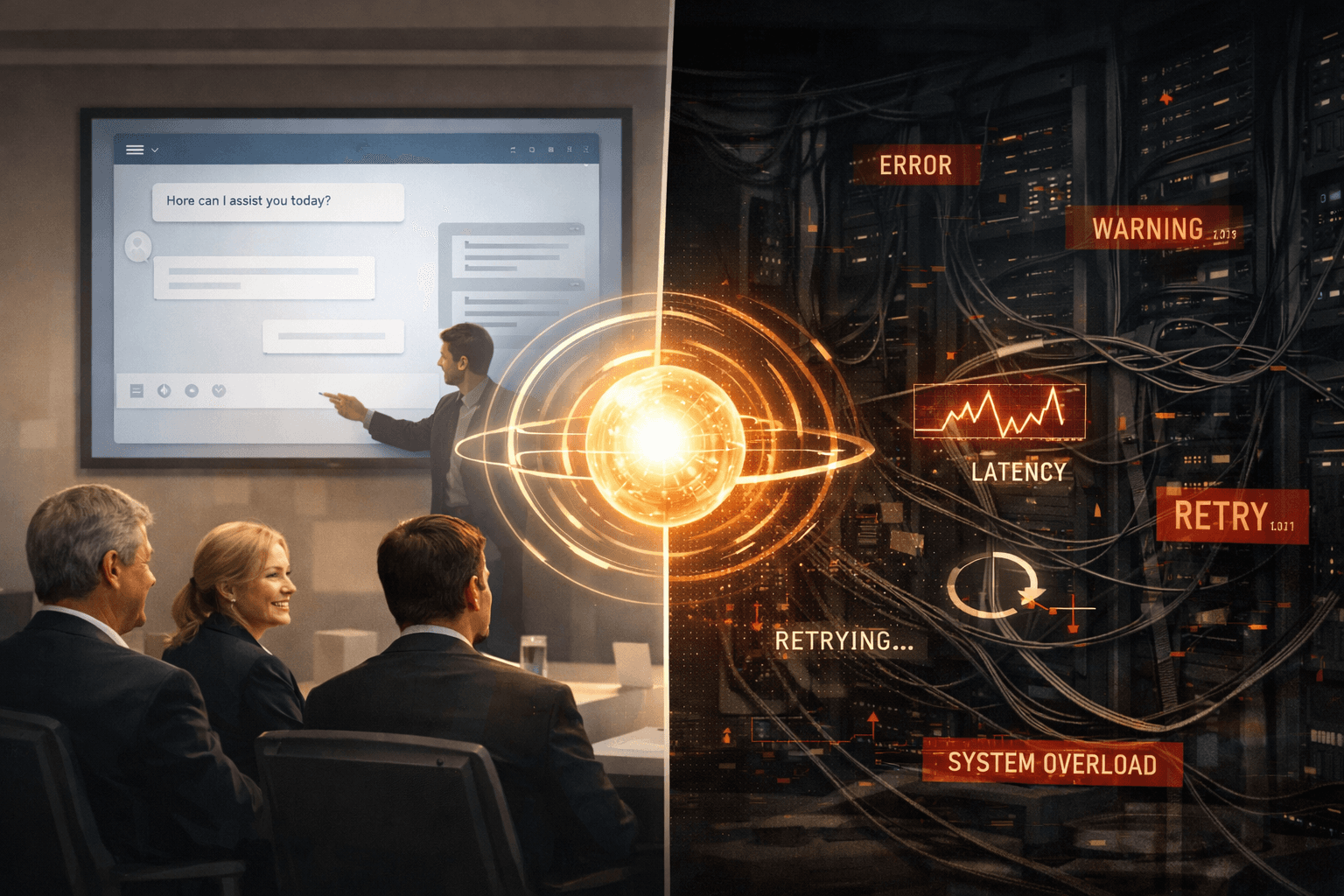
The agent booked meetings, summarized emails, even “reasoned” about follow-ups in real time. The room clapped. Two weeks later, it was quietly disabled after melting the queue, burning tokens like diesel, and getting stuck in polite apology loops at 2 a.m. Nothing exotic failed. Everything boring did. That’s the pattern I’ve seen for years: agentic MVPs don’t collapse because they’re too ambitious — they collapse because no one designs them for the part after the applause.
The Demo-to-Production Cliff Nobody Plans For
Agentic AI systems look deceptively sturdy in demos. A happy-path prompt, a single user, clean tools, fresh context. The illusion holds just long enough to convince everyone the hard work is done. In reality, the demo is the only moment your system experiences ideal conditions.
Production is hostile. Inputs are messy. Tools timeout. State leaks. Latency compounds. Token usage drifts upward week by week. When these systems fail, they don’t crash loudly. They degrade quietly. The agent still responds, but slower, dumber, and more expensive every day.
This is where most teams discover — too late — that what they built was not an AI agent architecture. It was a scripted conversation with delusions of autonomy.
Why agentic MVPs fail in production
The failure mode is consistent across industries and stacks. The agent is treated as a clever UI feature instead of a long-running distributed system. Decisions are delegated to a model without boundaries. State is assumed to “just exist.” Retries are added optimistically. Observability is postponed.
In production, the agent is suddenly asked to handle concurrency, partial failures, and ambiguous goals. Without explicit control layers, the model starts compensating. It retries tools aggressively. It hallucinates state continuity. It expands prompts to reason its way out of uncertainty. Costs spike. Latency budgets evaporate. Eventually, someone turns it off and calls it a “learning experience.”
The uncomfortable truth is that most MVPs were never meant to survive production traffic. They were meant to win budget approval.
Demos Optimize for Intelligence, Production Demands Restraint
During demos, teams reward the agent for sounding smart. In production, sounding smart is irrelevant. Being predictable matters more. An agent that refuses to act when confidence drops is infinitely more valuable than one that confidently does the wrong thing.
Production agents need ceilings. Hard caps on retries. Hard limits on context growth. Explicit refusal paths. If your agent cannot say “I don’t know” or “this requires a human,” it will invent momentum. That momentum becomes retry storms, queue backpressure, and cascading tool failures.
This is where many teams finally confront the difference between a model that can reason and a system that must behave.
The Silent Killer: State Management That Doesn’t Exist
Most agentic MVPs treat state as an afterthought. Context is passed forward optimistically. Memory is bolted on via embeddings. Session boundaries are vague. Everything works fine until the agent needs to recover from interruption.
Production agents are interrupted constantly. Processes restart. Workers scale horizontally. Requests arrive out of order. Without explicit state contracts, the agent reconstructs reality from fragments. That’s when duplicate actions happen. Emails resend. Tickets reopen. Payments retry.
State is not a prompt problem. It is an architectural problem. Once you internalize that, you start designing agents like systems instead of conversations. That realization usually arrives after reading about real agent lifecycle realities.
Common mistakes in AI agent demos
The most damaging demo mistake is hiding complexity. Tool responses are mocked. Latency is invisible. Error cases are skipped. The agent never sees a partial failure, so no one designs for it.
Another common mistake is letting the model orchestrate itself. The agent decides which tools to call, how often, and in what order. In demos, this feels magical. In production, it’s chaos. Tool calling failures cascade because nothing upstream enforces discipline.
A third mistake is assuming linear execution. Real agents are asynchronous. They wait. They resume. They collide with themselves. MVPs rarely simulate this. Production exposes it immediately.
These mistakes don’t look reckless at the time. They look efficient. That’s why they’re so expensive later.
Orchestration Is Not Optional, It’s the Product
If your agent has no orchestration layer, your model becomes the orchestrator by default. That is the most expensive control plane you could possibly choose.
Orchestration is where you enforce sequencing, retries, fallbacks, and escalation paths. It’s where you decide which failures are fatal and which are recoverable. It’s also where you prevent the model from improvising its way into disaster.
Teams that survive production build explicit orchestration patterns early, often borrowing ideas from workflow engines and message-driven systems. This is why mature systems start to resemble the designs discussed in orchestration patterns, not chat apps with extra steps.
There’s a brief digression worth making here.
Years before LLMs, we learned this lesson with microservices. Everyone let services call each other freely. Then the retries started. Then the timeouts. Then the circuit breakers. Agents are repeating that entire arc in fast forward. The difference is that now the caller is probabilistic.
Once you see that parallel, you stop trusting “smart” behavior without guardrails.
Scaling agentic systems beyond prototypes
Scaling an agent is not about adding more workers. It’s about controlling coordination. Horizontal scaling multiplies state problems, not solves them. Every new replica increases the chance of duplicated actions unless state ownership is explicit.
Latency budgets matter here. Each tool call adds uncertainty. Each retry adds delay. At small scale, you ignore it. At production scale, latency becomes user-visible and business-critical.
Teams that succeed treat agents like distributed workers with strict contracts. They externalize queues. They enforce idempotency. They isolate slow tools. They understand the horizontal scaling trade-offs instead of discovering them through outages.
This is also where token economics finally get real. An agent that reasons twice as much under load is not “thinking harder.” It is burning money because the architecture failed to constrain it.
Observability Gaps Make Failures Look Random
When agents fail, they often fail invisibly. Logs capture text, not intent. Metrics track latency, not confusion. Traces show tool calls, not decision paths.
Without observability designed for agents, teams misdiagnose issues. They tweak prompts instead of fixing orchestration. They increase context windows instead of fixing state leaks. They blame models for architectural failures.
Good agent observability tracks decisions, retries, and refusals. It shows when the agent is compensating. Once you can see that, many “model problems” disappear overnight.
The Myth of Autonomous Agents
The word “autonomous” has done more damage to agentic systems than any bad API. Autonomy suggests independence. Production demands interdependence with constraints.
Every successful production agent I’ve reviewed is deeply supervised. Not by humans in the loop, but by systems that constrain behavior. Timeouts. Budgets. Escalation rules. Kill switches.
Autonomy without governance is not innovation. It’s negligence dressed as progress.
Why Experience Beats Cleverness Every Time
Senior teams eventually converge on the same conclusions, usually after one painful quarter. Intelligence must be bounded. State must be explicit. Orchestration must be boring. Scaling must be intentional.
None of this shows well in a demo. All of it determines whether the agent survives contact with reality.
If you’re serious about production AI agents, stop asking how smart your model is. Start asking how it fails, how it recovers, and how much damage it can do before someone notices.
That’s the difference between an MVP that impresses and a system that lasts.
Sometimes progress comes faster with another brain in the room. If that helps, let’s talk — free consultation at Agents Arcade .
Majid Sheikh is the CTO and Agentic AI Developer at Agents Arcade, specializing in agentic AI, RAG, FastAPI, and cloud-native DevOps systems.