
Choosing Between Single-Agent, Supervisor, and Multi-Agent Architectures
Most teams reach for multi-agent setups far too early. Somewhere along the way, “more agents” became shorthand for “more capable,” and that assumption quietly wrecks budgets, latency targets, and on-call rotations. I’ve watched perfectly sane systems collapse under orchestration complexity that nobody planned to own. The uncomfortable truth is that the most impressive agent demos often scale the worst. If you’re serious about shipping something that survives real users and real traffic, architecture choice isn’t a style preference. It’s a constraint negotiation with physics, economics, and human attention.
The uncomfortable baseline: most problems don’t need more agents
After a decade of building and rescuing agentic systems, the pattern is depressingly consistent. Teams overestimate coordination gains and underestimate coordination costs. Every additional agent introduces message passing, state management, and new failure modes. Those costs compound non-linearly. This is why I push architects to start with the smallest viable control plane and justify every step away from it.
Agent orchestration isn’t free. Tool calling has overhead. Context windows inflate. Token economics stop being theoretical the moment finance asks why inference spend doubled without user growth. Once you internalize that, architecture stops being a thought experiment and starts looking like systems engineering again.
When to use a single-agent architecture
A single-agent architecture is not a beginner’s compromise. It’s a disciplined choice. If your system has a clear objective, bounded tool surface, and sequential reasoning paths, a single agent with well-designed prompts and tools will outperform any distributed setup on cost, debuggability, and reliability.
The strongest signal that a single agent is enough is when task decomposition is deterministic. If you already know the steps, you don’t need agents negotiating who does what. You need an execution engine that doesn’t hallucinate responsibility boundaries. Single agents shine when latency budgets are tight, because there’s no cross-agent chatter to serialize. They also shine when state must remain coherent, because there’s only one place it can live.
This is where frameworks like LangGraph get misused. People see graphs and assume multiplicity. In practice, LangGraph is just as effective for structuring a single agent’s control flow, especially when you want explicit checkpoints, retries, and error handling without splitting cognition across entities. The moment you realize that orchestration logic is just code, not intelligence, single-agent designs start to look refreshingly sane.
I’ve seen production systems serve millions of requests per day with one agent, a handful of tools, and ruthless prompt discipline. The reason they work is not magic. It’s because their architects resisted the urge to anthropomorphize software.
Supervisor agent vs multi-agent systems
The supervisor pattern is the most misunderstood middle ground in AI agent architecture. Conceptually, it promises the best of both worlds: specialized agents coordinated by a higher-level controller. In reality, it’s a tax you pay for organizational anxiety.
A supervisor agent makes sense when tasks are genuinely heterogeneous and require different reasoning styles or tool access domains. Think regulatory analysis versus free-form synthesis, or real-time operations versus offline research. The supervisor’s job is not to think creatively. It’s to route, sequence, and recover. When people forget that, the supervisor becomes an expensive meta-thinker that adds latency without adding clarity.
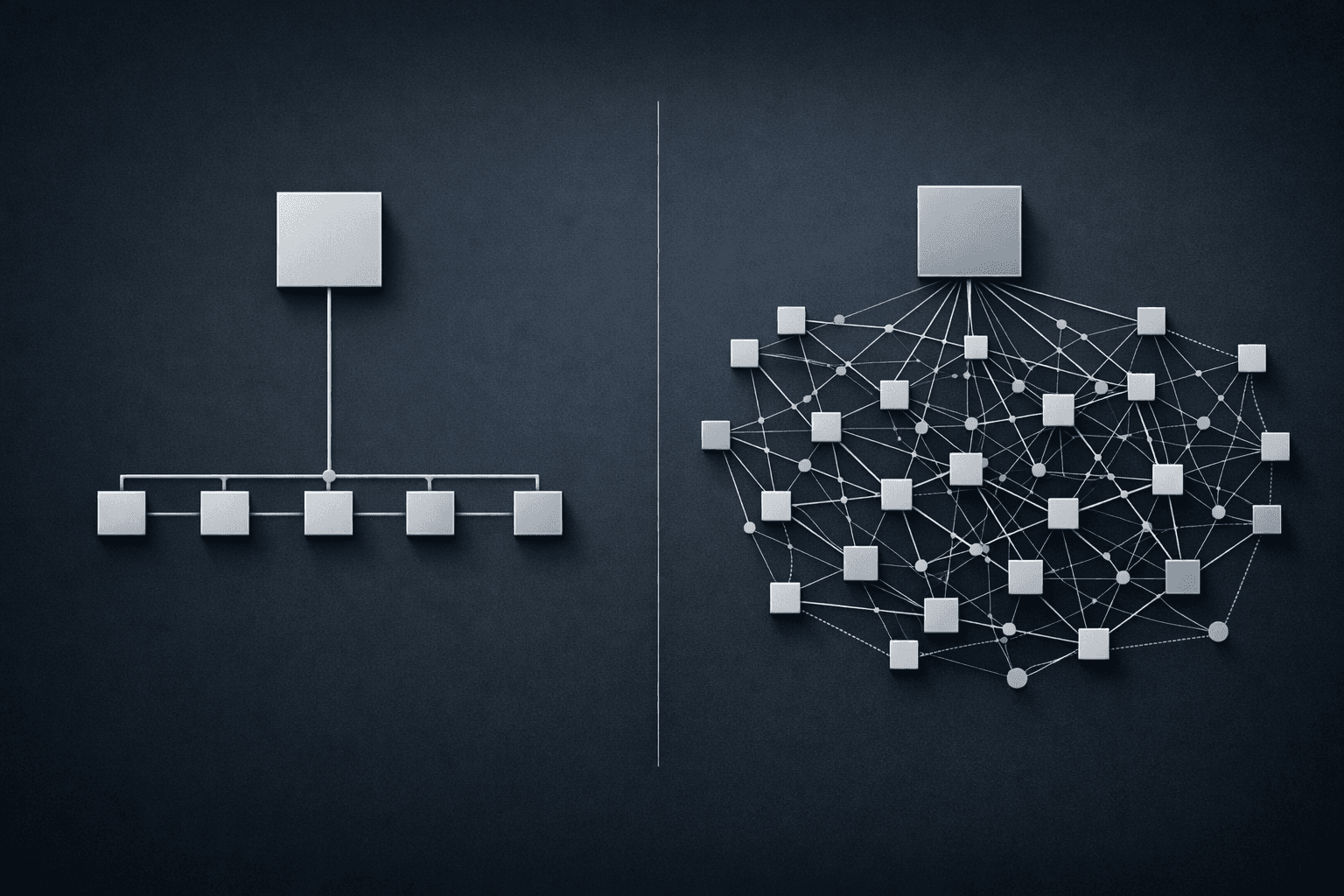
The critical distinction between a supervisor agent and a full multi-agent system is authority. In a supervisor setup, the control plane is centralized. Decisions flow down, results flow up, and state is reconciled in one place. That containment is what keeps failure modes understandable. If an agent misbehaves, you know who sent it there.
This is where experience with common agent orchestration patterns matters. Patterns exist to reduce entropy, not to showcase cleverness. A supervisor architecture that lacks strict contracts between agents is worse than chaos, because it gives the illusion of order while quietly leaking complexity.
Scaling challenges in multi-agent architectures
Here’s the part nobody likes to admit: multi-agent architectures scale poorly by default. Not linearly, not gracefully, and not predictably. Every agent boundary introduces synchronization costs. Every shared memory abstraction becomes a contention point. Every retry policy multiplies token usage.
Latency budgets suffer first. What looks parallel on a whiteboard often serializes in practice due to tool dependencies and state locks. Then cost curves spike. Token economics don’t care that agents feel autonomous. They care about how many times context is rehydrated and how often models repeat reasoning that could have been cached.
Failure modes get creative. Partial success becomes ambiguous. Did the system fail, or did Agent C succeed while Agent D timed out? Observability becomes a research project. By the time you’ve built tracing robust enough to answer those questions, you’ve effectively built a distributed system with LLMs as the least predictable components.
This is why I keep pointing teams back to practical guidance on building and scaling agentic systems. Not because multi-agent systems are bad, but because they demand production discipline most teams underestimate.
There is a narrow class of problems where multi-agent architectures are justified. They usually involve open-ended exploration, competitive hypothesis generation, or environments where redundancy is more valuable than efficiency. Even then, success depends on aggressively constraining communication, enforcing state ownership, and accepting that some agent work will be thrown away.
A necessary digression on human teams and agent teams
I’ve noticed something uncomfortable over the years. Teams often design agent architectures that mirror their org charts. Supervisors look like managers. Specialized agents look like departments. Multi-agent systems look like committees. This feels intuitive, but it’s usually wrong.
Human organizations optimize for social constraints, not computational efficiency. We split work because humans have cognitive limits and political realities. Agents don’t get tired, don’t need buy-in, and don’t resent central control. When you copy human structures into software, you inherit inefficiencies without inheriting the reasons they exist.
This is why multi-agent designs often feel elegant but behave poorly. They encode assumptions about collaboration that make sense for people, not for deterministic machines with stochastic outputs. The moment you accept that agents are tools, not coworkers, architectural clarity improves.
Now back to the core issue: choosing the right structure before these metaphors do real damage.
Orchestration overhead is the real bottleneck
Most postmortems I’ve read blame model quality when systems fail. That’s almost always a misdiagnosis. The real culprit is orchestration overhead. Control planes grow organically. Message passing paths multiply. State management logic becomes implicit. Eventually, nobody can reason about end-to-end behavior.
Single-agent systems minimize this by design. Supervisor architectures contain it if done ruthlessly. Multi-agent systems amplify it unless actively suppressed. This is why experienced teams invest more in orchestration code than in prompt tweaks. The intelligence layer is only as good as the rails it runs on.
Tool calling deserves special mention here. Every tool invocation is an opportunity for latency inflation and partial failure. In multi-agent setups, tools become shared resources with implicit coupling. Without explicit ownership rules, agents step on each other’s toes in subtle ways that only appear under load.
Cost modeling should precede architecture choice
If you’re not modeling cost before committing to an architecture, you’re guessing. Token economics are unforgiving. A single-agent system with long contexts may be expensive, but it’s usually predictable. A multi-agent system with short contexts can still explode in cost due to retries, supervision loops, and redundant reasoning.
This is where horizontal scaling strategies matter. Throwing more replicas at an inefficient architecture just accelerates spend. Thoughtful designs informed by real-world scaling approaches for agent backends often outperform more “intelligent” systems simply because they respect budgets and latency ceilings.
I’ve had uncomfortable conversations where the technically superior design lost to the financially survivable one. That’s not failure. That’s engineering.
Choosing deliberately, not aspirationally
The architecture you choose should reflect the problem you actually have, not the one you hope to impress people with. Single-agent systems are not primitive. Supervisor patterns are not stepping stones. Multi-agent architectures are not badges of maturity. They are tools with sharp edges.
If you can’t explain where state lives, who owns retries, and how failures propagate, you’re not ready for more agents. If you can’t trace a request end-to-end without a diagram and a prayer, you’ve already crossed the complexity threshold.
The teams that succeed are the ones that choose architectures the way pilots choose instruments: conservatively, with respect for limits, and with a bias toward what keeps them in the air when conditions get bad.
If you’d benefit from a calm, experienced review of what you’re dealing with, let’s talk. Agents Arcade offers a free consultation.
Majid Sheikh is the CTO and Agentic AI Developer at Agents Arcade, specializing in agentic AI, RAG, FastAPI, and cloud-native DevOps systems.