
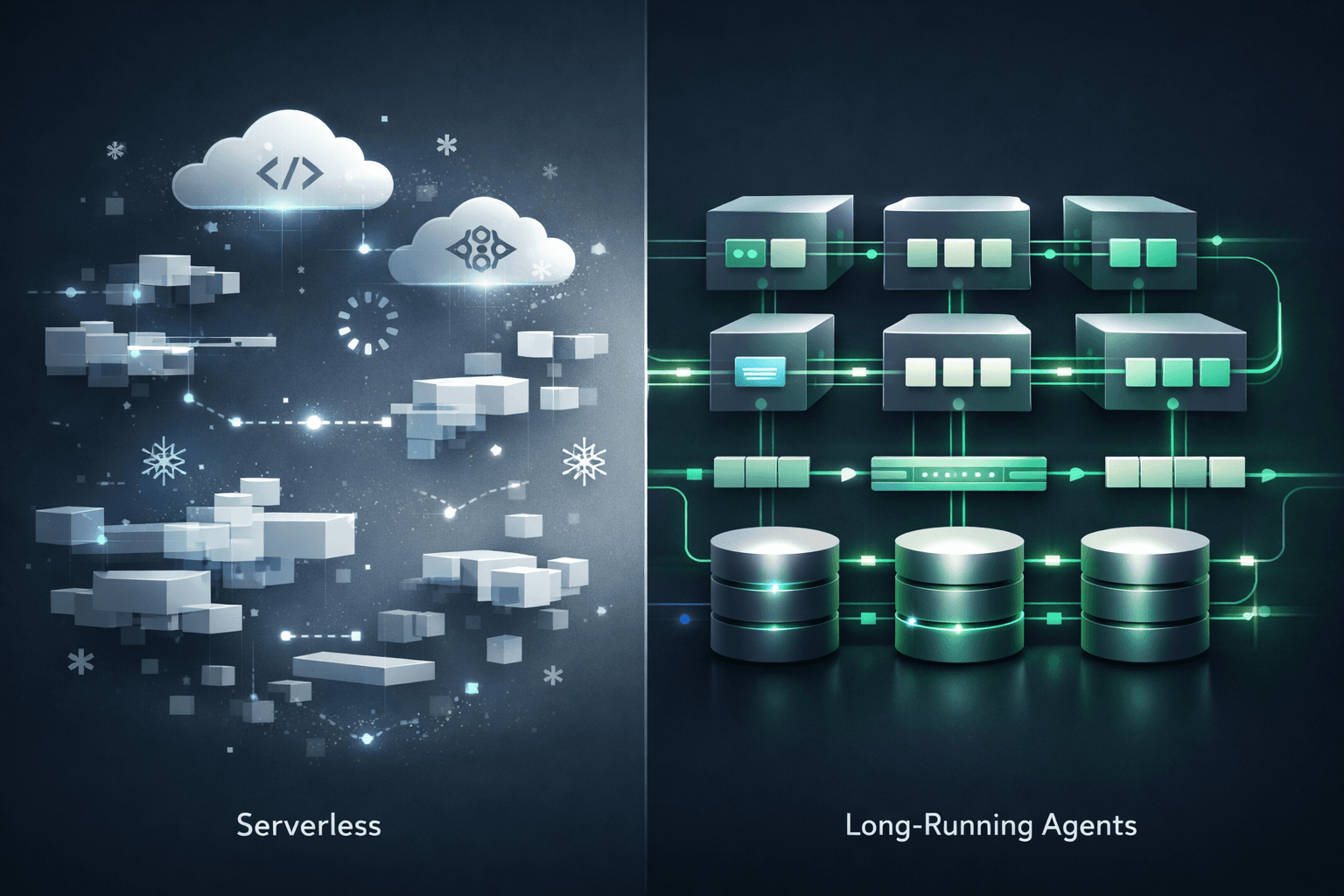
Serverless vs Long-Running AI Agents: Architecture Trade-offs in Production
Everyone keeps pushing serverless as the default answer for AI systems. I don’t buy it. I’ve deployed enough real-world agent systems to watch that narrative break the moment things move beyond demos.
Serverless works beautifully in slides. It fails quietly in production when latency spikes, state disappears, and workflows stretch beyond a single request-response cycle. Meanwhile, long-running agents look messy on paper, but they actually survive real workloads.
I’ve built both. I’ve fixed both. And I’ll take a well-designed long-running system over a naive serverless deployment every single time.
The Reality of AI Agents in Production
AI agents don’t behave like APIs. They don’t follow neat request-response patterns. They:
- Hold context across multiple steps
- Call tools asynchronously
- Stream tokens while still computing
- Retry, branch, and recover mid-execution
You don’t “handle a request.” You orchestrate a workflow.
That difference changes everything.
Most teams start with serverless because it feels cheap, scalable, and modern. Then the system evolves:
- The agent needs memory persistence
- The workflow spans minutes, not seconds
- The user expects streaming responses
- Tool calls introduce unpredictable latency
Now your “stateless function” starts pretending to be a stateful system.
That’s where things crack.
If you don’t design around agentic system design principles, you end up duct-taping state, retries, and orchestration into something that was never meant to hold them.
Serverless AI: Where It Actually Works
Let’s be fair. Serverless isn’t useless. I use it when the problem fits.
Serverless works when:
- You run short-lived inference tasks
- You process isolated events (e.g., webhook → classify → respond)
- You don’t need persistent memory
- Latency spikes don’t break UX
Typical use cases I’ve deployed successfully:
- Content classification pipelines
- Simple chat completions without memory
- Event-triggered summarization jobs
- Stateless tool wrappers
In these cases, serverless gives you:
- Automatic scaling
- Minimal infrastructure overhead
- Clean deployment boundaries
But notice what’s missing: stateful orchestration.
The moment your agent needs to think over time, serverless starts fighting you.
Long-Running AI Agents: The Systems Nobody Wants to Maintain
Long-running agents don’t look elegant. They require:
- Persistent workers
- State management layers
- Queue systems
- Failure handling logic
You don’t just deploy code. You run a system.
But here’s the truth: serious AI products require this.
When I build long-running agents, I usually stack something like:
- FastAPI for orchestration APIs
- Redis or Kafka for queues
- Celery or custom workers for execution
- Docker for isolation
- Kubernetes when scale demands it
Now I can:
- Maintain conversation state
- Stream tokens in real-time
- Retry failed tool calls
- Resume workflows mid-execution
This setup feels heavier. It is heavier. But it matches how agents actually behave.
serverless vs long-running ai agents performance comparison
Let’s cut through theory and talk about what actually breaks under load.
Latency
- Serverless:
- Cold starts kill responsiveness
- Token streaming becomes awkward
- Multi-step workflows amplify delays
- Long-running:
- Warm workers eliminate startup delays
- Streaming works naturally
- Latency stabilizes under load
State Handling
- Serverless:
- Forces external state hacks (DB, cache, payload stuffing)
- Hard to maintain consistency across steps
- Long-running:
- Keeps state in memory or controlled storage
- Enables real workflow continuity
Throughput
Serverless:- Scales horizontally fast
- But cost grows unpredictably with chained calls
Long-running:- Predictable throughput via worker pools
- Easier to optimize resource usage
Developer Experience
- Serverless:
- Easy to start
- Hard to debug multi-step failures
- Long-running:
- Harder to build
- Easier to reason about complex workflows
I’ve watched teams burn weeks debugging distributed serverless chains that should’ve been a single worker loop.
when to use serverless for ai agents in production
I still use serverless. I just don’t pretend it solves everything.
Use serverless when:
- The agent does one thing per trigger
- Execution time stays under strict limits
- You don’t need conversational memory
- You can tolerate occasional cold-start latency
I treat serverless as a utility layer, not a core architecture.
For example:
- Trigger an agent run → enqueue job → worker handles logic
- Pre-process data before sending to a long-running system
- Run lightweight validation or enrichment
If you try to build the entire agent lifecycle in serverless, you’ll fight the platform more than the problem.
That’s also where teams start looking for external help. A good ai agent development company will push you away from overusing serverless, not deeper into it.
challenges of long-running ai agent workflows
Now let’s be honest about the other side. Long-running systems don’t magically solve everything.
They introduce real engineering problems:
State Management
You must decide:
- Where does memory live?
- How do you version it?
- What happens on partial failure?
Bad state design will corrupt workflows faster than any serverless issue.
Failure Handling
Agents fail in weird ways:
- Tool timeouts
- Partial outputs
- Broken chains
You need retry logic, idempotency, and checkpoints.
Resource Management
Workers consume:
- CPU (token generation)
- Memory (context storage)
- Network (tool calls)
Without control, costs spiral.
Observability
You need deep visibility:
- Step-level logs
- Token usage tracking
- Workflow tracing
Otherwise, debugging becomes guesswork.
This is where many teams underestimate complexity. They build a demo agent, then panic when it becomes a system.
If you want to control cost and complexity, you should study token usage optimization strategies early. Most teams do this too late.
A Failure Story: When Serverless Broke the System
I worked with a team that built a customer support agent entirely on serverless functions.
It looked clean:
- Each step was a function
- State passed through payloads
- Tool calls triggered new functions
Then production traffic hit.
Problems showed up immediately:
- Cold starts added 2–4 seconds per step
- Payloads grew huge as state accumulated
- One failed function broke the entire workflow
- Streaming responses became impossible
Users saw laggy, fragmented responses. The system felt broken.
We rebuilt it.
We moved orchestration into a FastAPI service with:
- Redis queues
- Long-running workers
- Persistent conversation state
Now the agent:
- Streamed responses in real-time
- Recovered from failures
- Reduced latency by over 60%
The architecture looked “less modern.” It worked.
That experience changed how I approach every agent system.
Hybrid Architecture: The Only Sensible Default
I don’t recommend choosing one model. I recommend combining both.
Here’s how I design production systems now:
Use Serverless For:
- Event ingestion
- Lightweight preprocessing
- External triggers
Use Long-Running Workers For:
- Core agent orchestration
- Multi-step reasoning
- Tool execution chains
- Streaming responses
Add a Queue Layer
- Decouple triggers from execution
- Smooth traffic spikes
- Enable retries and backpressure
This hybrid approach gives you:
- Flexibility
- Stability
- Cost control
And it aligns with how real systems behave.
You can further refine performance using latency and streaming optimization techniques, especially when balancing user experience against infrastructure constraints.
Where Most Architectures Go Wrong
I keep seeing the same mistakes:
- Treating agents like REST APIs
- Ignoring state complexity
- Overusing serverless for orchestration
- Underestimating failure scenarios
Teams optimize for:
- Fast deployment
- Low initial cost
But production demands:
- Reliability
- Observability
- Control
Those require deliberate architecture, not shortcuts.
The Cost Conversation Nobody Has Honestly
Serverless looks cheap at the start. It rarely stays that way.
Hidden costs include:
- Chained function executions
- Repeated context reconstruction
- Increased token usage due to statelessness
- Debugging time
Long-running systems cost more upfront:
- Infrastructure setup
- Operational overhead
But they reduce:
- Redundant computation
- Token waste
- Latency penalties
Over time, they often become cheaper and more predictable.
This is exactly where experienced ai agent development services make a difference. Cost optimization doesn’t come from tooling—it comes from architecture decisions.
Final Thoughts: Stop Chasing Simplicity
Serverless promises simplicity. AI agents demand complexity.
You can ignore that reality for a while. Eventually, production forces you to face it.
I don’t reject serverless. I reject using it blindly.
Build systems that match the behavior of your agents:
- Stateful when needed
- Async by design
- Observable at every step
And most importantly—accept that real AI systems look more like distributed systems than APIs.
If you’d benefit from a calm, experienced review of what you’re dealing with, let’s talk. Agents Arcade offers a free consultation.
Majid Sheikh is the CTO and Agentic AI Developer at Agents Arcade, specializing in agentic AI, RAG, FastAPI, and cloud-native DevOps systems.