
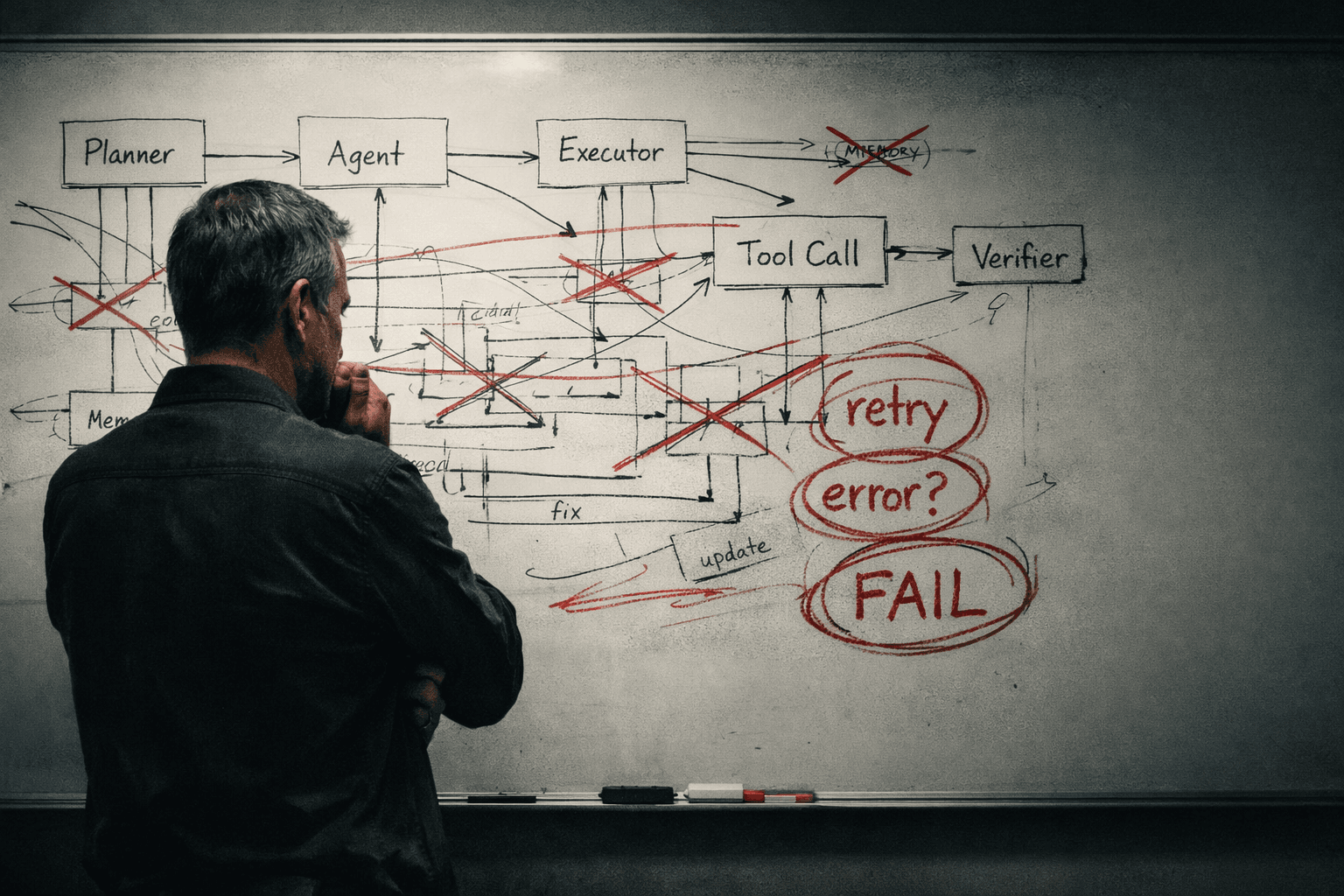
Multi-agent systems: Benefits & pitfalls in real projects.
I’ll start with a prediction that’s already half true.
In two years, most teams who rushed into multi-agent systems will quietly roll them back. Not because agents don’t work. Because they worked just enough to get approved—and just poorly enough to become operational debt.
If you want the broader context on *how modern AI agents plan, reason, and coordinate workflows — and where multi‑agent systems fit into that picture — check out our comprehensive guide on AI agent workflows .
I’ve seen this cycle before. SOA. Then microservices. Then event-driven everything. Each wave had a real technical core and an even larger halo of bad implementations justified by blog posts and conference talks. Agentic systems are following the same arc, just faster, because LLMs remove friction and add illusion.
Multi-agent systems are powerful. They are also brittle, expensive, and deeply unforgiving of architectural laziness. The gap between a demo that impresses leadership and a system that survives production traffic is wide. Painfully wide.
If you’re evaluating or already building agentic architectures, you need fewer abstractions and more scar tissue. Let’s talk about both.
The real promise behind multi-agent systems
At their best, multi-agent systems give you something monolithic LLM calls never will: constrained autonomy. You decompose a problem into semi-independent reasoning units, give each one tools and context, and let coordination emerge through message passing and contracts rather than a single bloated prompt.
This is not about “multiple chats talking to each other.” It’s about isolating cognitive responsibilities the same way we once isolated business capabilities. Planner agents, retrievers, verifiers, execution agents, critics. When done right, each agent has a sharply defined failure surface. When one goes off the rails, it does so loudly.
This is why agentic AI architectures feel so compelling to senior engineers. They map cleanly onto decades of distributed systems thinking. Boundaries. Protocols. Explicit interfaces. Observable state transitions. You can reason about them. You can test them. At least in theory.
In practice, that theory collapses quickly if you don’t respect the costs you’re introducing.
when multi-agent systems actually make sense
Here’s the uncomfortable truth: most teams don’t need agents. They need better prompts, stricter schemas, and fewer product requirements disguised as intelligence.
Multi-agent systems make sense when the problem itself is irreducibly multi-step, non-deterministic, and benefits from competing hypotheses. Think long-horizon planning, complex research synthesis, compliance-heavy workflows, or environments where tool calls have side effects that must be validated independently.
They also make sense when you cannot afford a single point of cognitive failure. A lone “do everything” agent is a liability once decisions have real consequences. Separating planning from execution, and execution from verification, is not overengineering in those cases. It’s risk management.
What does not justify agents is simple CRUD augmentation, basic RAG over a static corpus, or customer support flows that could be handled with state machines and retrieval. I’ve watched teams build five-agent orchestration graphs to answer questions that a single well-instrumented LLM call could handle more cheaply and more reliably.
Agents are not a shortcut to sophistication. They are a tax you pay to manage complexity that already exists.
The hidden coordination tax nobody budgets for
The moment you introduce more than one agent, you are no longer building an AI feature. You are building a distributed system with stochastic nodes.
Agent coordination is where most projects quietly bleed out. Not in spectacular outages, but in subtle degradation. Slightly longer response times. Slightly higher token usage. Occasional hallucinated tool calls that no one can reproduce.
Frameworks like LangGraph and AutoGen give you structure, but they don’t remove the fundamental problem: you now have emergent behavior. Message ordering matters. Context windows interact. Small prompt changes ripple across the system in ways that are difficult to predict.
This is where teams get burned. They assume orchestration overhead is linear. It isn’t. Each additional agent multiplies the number of interaction paths you need to reason about. Add memory, retries, or fallback agents, and the state space explodes.
If you don’t invest early in tracing, correlation IDs, and replayable runs, you will end up debugging by vibes. I’ve seen senior teams reduced to re-running prompts manually, hoping the failure reproduces. That’s not engineering. That’s superstition.
coordination failures in agent-based architectures
Let’s be precise about failure modes, because they repeat.
One common failure is goal drift. Agents optimize locally based on their prompts, not globally based on your product intent. A planner agent decomposes tasks in a way that looks reasonable but explodes cost. An execution agent follows instructions too literally and triggers unnecessary tool calls. A verifier agent becomes overly conservative and blocks progress.
Another is context poisoning. One agent injects flawed assumptions into shared memory, and downstream agents treat it as ground truth. By the time the error surfaces, it’s several hops removed from the source. Good luck explaining that to stakeholders.
Then there’s deadlock by politeness. Agents defer to each other, ask clarifying questions in loops, or wait for signals that never arrive. Humans do this too, but we recognize it socially. Agents don’t. Without hard stop conditions, your system just… stalls.
These are not edge cases. They are the default unless you design explicitly against them.
cost and latency tradeoffs in multi-agent systems
Every agent you add amplifies cost. Not just tokens, but retries, tool calls, vector searches, and latency variance. The worst part is that this amplification is often invisible during early testing, when inputs are clean and traffic is low.
In production, messy user input forces agents into longer reasoning paths. Tool calls fail intermittently. Retrievers return noisy results. Suddenly your elegant graph is making twelve LLM calls where you expected four.
Latency compounds as well. Even with parallel execution, coordination points introduce waits. Users feel this. They don’t care that your architecture is clever. They care that the answer took eight seconds instead of two.
I’ve had teams insist this was acceptable because “the quality is better.” Sometimes it was. Often it wasn’t measurably so. Quality improvements that cannot be explained, benchmarked, and justified against cost are not improvements. They’re opinions.
This is why I push teams to model cost early. Not roughly. Explicitly. Worst-case paths, not happy paths. If the numbers make you uncomfortable, listen to that instinct.
The microservices déjà vu you should not ignore
Here’s the digression I promised.
Around 2015, everyone wanted microservices. Teams decomposed systems without understanding operational overhead. They traded local complexity for global fragility. Observability lagged. On-call pain spiked. Eventually, the industry recalibrated.
Agentic systems are replaying this pattern. We are decomposing cognition instead of services, but the dynamics are familiar. More boundaries mean more failure modes. More flexibility means more responsibility.
The teams that succeed will not be the ones with the most agents. They will be the ones with the fewest agents necessary, each with ruthless scope control. The rest will quietly merge agents back together and call it “optimization.”
History doesn’t repeat, but it absolutely rhymes.
Tool calling is where theory meets reality
Tool calling looks clean in diagrams. In practice, it’s a minefield.
Agents need to know when to call tools, how to validate responses, and how to recover from partial failures. Tool schemas drift. APIs return unexpected shapes. Rate limits kick in at the worst possible time.
If you let agents decide too freely, they will over-call tools. If you constrain them too tightly, they will underperform. Finding the balance is less about prompt cleverness and more about guardrails and feedback loops.
One hard-earned lesson: never let an agent both decide and execute irreversible actions without a separate verification step. This is not paranoia. It’s production hygiene.
Observability is not optional, it’s the product
If you cannot answer why an agent made a decision, you do not have a system. You have a demo.
Real-world multi-agent systems require first-class observability. Traces that show agent-to-agent messages. Logs that include prompt versions. Metrics that track token usage per path, not per request.
Without this, you cannot tune behavior. You cannot reduce cost. You cannot explain failures. You will eventually lose trust internally, which is fatal for any AI initiative.
This is where many teams underestimate the work involved. Observability is not a bolt-on. It shapes how you design agents, how you pass context, and how you persist state.
Choosing frameworks without surrendering control
LangGraph, AutoGen, and similar tools are useful. They encode patterns, reduce boilerplate, and accelerate experimentation. They are not architecture.
The mistake I see is teams adopting a framework’s mental model wholesale. They design around what the framework makes easy, not what the problem demands. Six months later, they’re fighting abstractions instead of shipping value.
Use frameworks tactically. Understand what they generate. Know where you can step outside them. Your system should be understandable without reading framework source code at 2 a.m.
A hard line on overuse
I’ll say this plainly. If your agent graph is growing because it feels elegant, stop. Elegance is not a metric.
Every agent must justify its existence with a concrete risk it reduces or a capability it enables that simpler designs cannot. If you can collapse two agents without losing those properties, you probably should.
I’ve seen too many teams mistake architectural enthusiasm for progress. The result is systems that are impressive to explain and painful to operate.
Where this leaves us
Multi-agent systems are not hype. They are also not a default. They are a specialized tool for specialized problems, and they demand senior-level discipline to execute well.
If you’re willing to invest in observability, cost modeling, failure analysis, and ongoing tuning, agents can unlock workflows that were previously impractical. If you’re not, they will quietly erode reliability while everyone pretends it’s fine.
I’ve shipped both kinds. The difference was never the framework. It was the willingness to say no, early and often.
If you’re building or evaluating agentic systems and want a brutally honest second opinion before complexity sets in, book a free consultation with us. I’d rather help you design the right system now than help you unwind the wrong one later.
Looking for guidance from the pros? Visit Agents Arcade and start the conversation.
Majid Sheikh is the CTO and Agentic AI Developer at Agents Arcade, specializing in agentic AI, RAG, FastAPI, and cloud-native DevOps systems.