
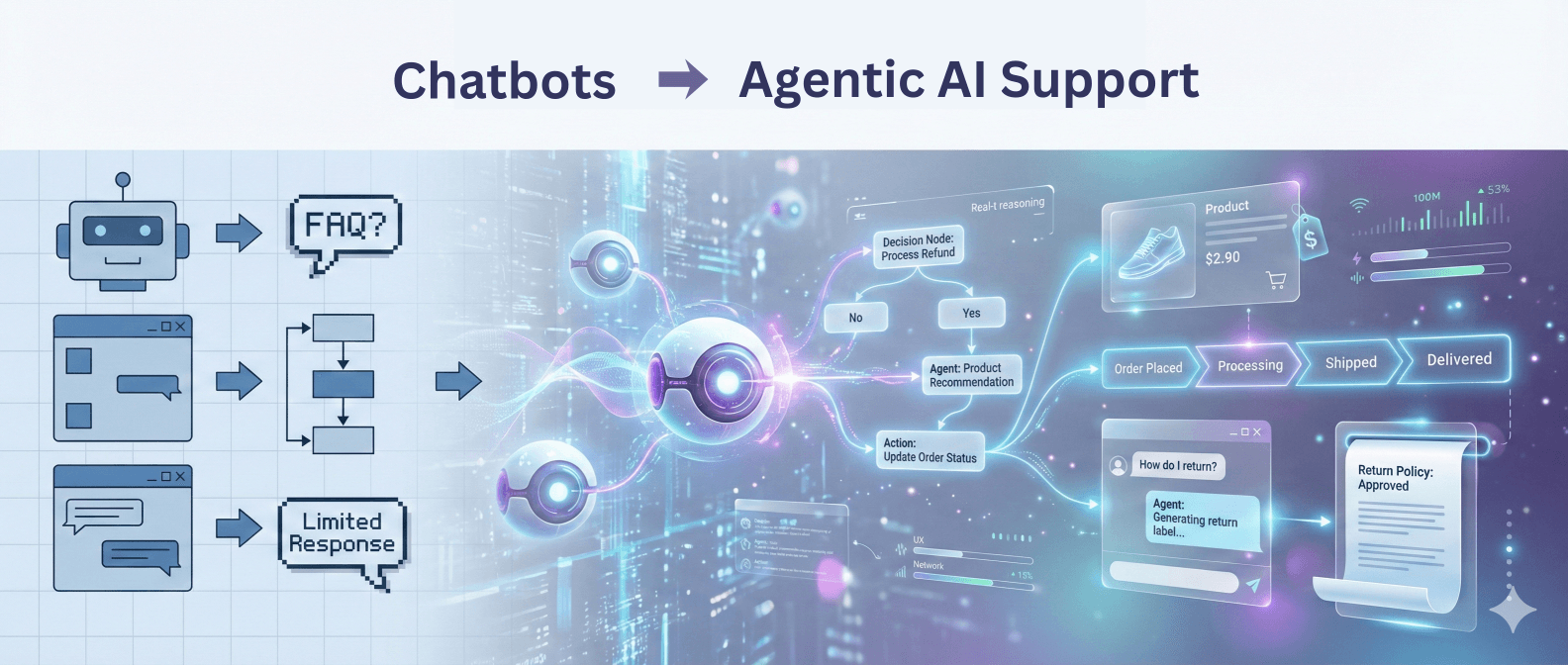
How Agentic Workflows Are Replacing Traditional “Chatbots”
For years, businesses relied on traditional chatbots to automate customer interactions. These chatbots could provide preset answers, respond with scripted flows, and handle simple FAQs. But as customer expectations grew and digital ecosystems became more complex, the limitations of traditional chatbots became impossible to ignore.
To understand the full scope of how AI agents work — including planning, reasoning, tool use, and real-world deployment — check out our comprehensive Practical Guide to AI Agents .
Today, a new approach is taking over: agentic workflows powered by advanced AI agents. These agents don’t just “chat.” They understand, reason, take actions, trigger workflows, and complete tasks end-to-end. This shift marks one of the biggest transformations in customer support and business automation.
In this article, we’ll explore how agentic workflows work, why they are replacing traditional chatbots, and what this means for businesses using platforms like Shopify, WooCommerce, WordPress, and modern SaaS tools.
What Traditional Chatbots Could (and Couldn’t) Do
Traditional chatbots were built on simple underlying logic.
They could:
- Answer predefined questions
- Follow button-based decision trees
- Capture basic user information
- Offer limited scripted support
However, they could not:
- Pull real-time data from databases
- Make decisions based on rules or business logic
- Trigger automated workflows or actions
- Adapt to new situations
- Personalize responses beyond simple variables
This made them useful for basic support, but ineffective for anything complex.
Customers quickly realized when they were talking to a bot instead of getting real help.
What Are Agentic Workflows?
Agentic workflows are intelligent, autonomous AI-driven processes that allow an agent to:
- Understand the user’s intent
- Access business systems (APIs, databases, CRMs, Shopify/WooCommerce data)
- Analyze relevant information
- Make decisions based on rules or policies
- Take actions inside the business system
- Provide accurate, context-aware responses
Instead of chatting, they perform tasks.
Examples:
- Look up order status using a real API
- Check refund eligibility based on store policies
- Create content based on product data
- Emails or update CRM records
- Analyze customer sentiment and respond accordingly
This turns AI into a real team member rather than a simple customer-facing widget.
Why Agentic Workflows Are Replacing Traditional Chatbots
1. They Understand Real Intent, Not Just Keywords
Traditional chatbots depended on predefined patterns.
Agentic workflows use LLMs that understand natural language and subtle context.
Customers can speak naturally:
“I ordered shoes last week. They haven’t arrived. Can you check the status?”
The agent knows what to do.
2. They Can Take Real Actions
This is the biggest transformation.
Agents can:
- Query databases
- Pull order information
- Update tickets
- Generate shipping updates
- Apply refund rules
- Trigger an email or notification
- Retrieve product data
Traditional chatbots could never do this without complicated backend integration.
Agentic workflows handle it natively.
3. They Support Full Automation
Agentic workflows reduce the manual workload dramatically by automating entire processes:
- Customer support
- Returns and refunds
- Order tracking
- Product recommendations
- Marketing content creation
- Knowledge retrieval
- Internal team workflows
This allows businesses to operate faster, leaner, and more efficiently.
4. They Learn and Improve Over Time
Chatbots remain as they are unless someone updates their scripts.
Agentic systems learn from new data, previous conversations, and updated business logic.
The more the agent works, the smarter it becomes.
5. They Can Operate Across Multiple Channels
Agentic workflows function seamlessly across:
- Websites
- Shopify and WooCommerce storefronts
- Social platforms
- Email support
- Customer portals
- Internal dashboards
Traditional chatbots were often locked into a single UI.
Real Use Cases of Agentic Workflows in eCommerce
Order Lookup Agent
The agent retrieves order details by connecting to Shopify or WooCommerce APIs.
It then responds with real shipping info, not scripted templates.
Returns and Refund Automation Agent
The agent applies refund rules, checks eligibility, and prepares a response.
This reduces manual support time significantly.
Product Recommendation Agent
It analyzes product attributes, customer history, and inventory to recommend items.
Content Automation Agent
It creates product descriptions, SEO content, social posts, and email campaigns based on the store catalog.
Customer Support Agent
A fully autonomous support assistant capable of handling 60 to 70 percent of repetitive queries.
The Business Impact of Moving to Agentic Automation
Companies adopting agentic workflows report:
- Faster response times
- Higher customer satisfaction
- Lower support costs
- Fewer human errors
- More consistent information delivery
- Higher conversions and upsells
But most importantly, they create a scalable automation layer that grows with the business.
The Future Is Agentic, Not Chat-Based
As businesses continue to automate, simple chatbots will become obsolete.
Agentic workflows bring real intelligence, real actions, and real impact.
Businesses no longer want “a chatbot.”
They want a system that understands, decides, and completes tasks automatically.
This is why agentic automation is becoming the new standard across eCommerce, SaaS companies, service businesses, and enterprise support systems.
If you are building AI-powered systems or improving customer operations, agentic workflows should be at the center of your strategy.
Want Help Implementing Agentic Automation?
If your business uses Shopify, WooCommerce, or a custom stack and you want to adopt AI agents for automation, we can help you design and deploy real agentic workflows. Just click the Book Free Consultation button and schedule your free call.
If you want a smoother path forward, get support from Agents Arcade today.
Majid Sheikh is the CTO and Agentic AI Developer at Agents Arcade, specializing in agentic AI, RAG, FastAPI, and cloud-native DevOps systems.