
AI Agents for Internal Ops: Automating Workflows Without Breaking Systems
Most internal AI automation fails because teams treat agents like smarter cron jobs instead of volatile distributed systems that can mutate state, trigger side effects, and amplify small mistakes at machine speed. I see companies wire LLMs directly into ticketing, billing, or provisioning flows and then act surprised when something critical breaks. We built and fixed enough internal ops agents at Agents Arcade to learn this the hard way: if you don’t design for failure, state, and ownership, the agent will eventually take your system down with it.
I don’t argue against automation. I argue against reckless automation. Internal operations sit on the fault lines of your business: identity, money, access, compliance, and uptime. When an agent touches those seams, the blast radius grows fast. You can deploy AI agents for internal operations safely, but only if you stop pretending they’re assistants and start treating them like production services with teeth.
Why Internal Ops Is the Hardest Place to Put an Agent
Internal ops looks deceptively simple. The workflows feel repetitive. The inputs look structured. The stakeholders sit down the hall. That illusion tempts teams to move fast and glue an LLM to internal tooling.
In reality, ops workflows hide three properties that punish naïve agents.
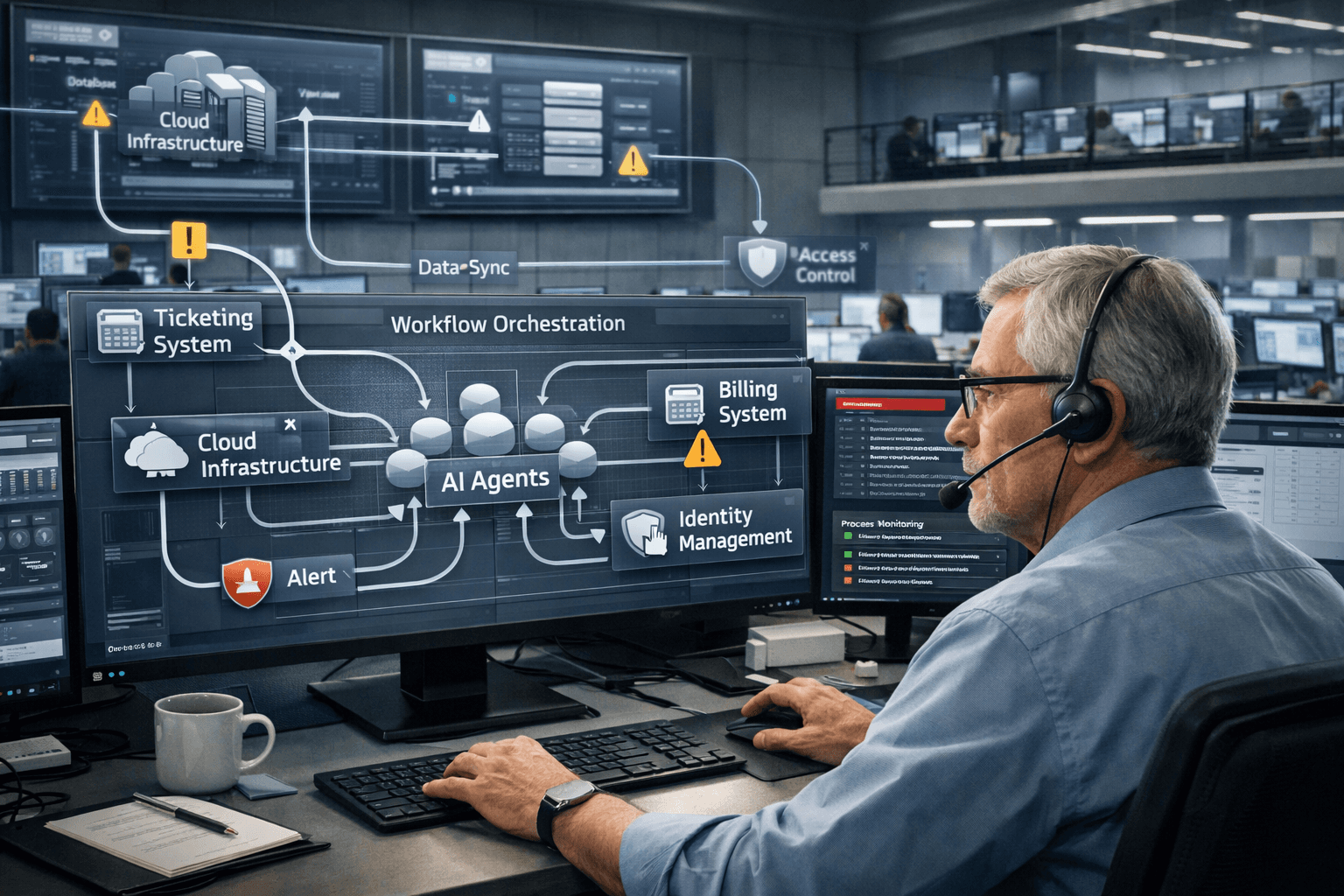
First, ops workflows span systems with incompatible failure modes. Your ticketing system retries silently. Your billing system refuses duplicates. Your cloud provider rate-limits aggressively. When an agent crosses those boundaries without coordination, it creates partial execution that humans struggle to unwind.
Second, ops workflows encode tribal knowledge. The steps “everyone knows” never appear in code. I watched agents execute the written procedure perfectly and still violate an unwritten constraint that only surfaced during audits or incidents.
Third, ops workflows demand reversibility. Humans pause when something smells wrong. Agents keep going unless you force them to stop. If you don’t build brakes, the agent will happily dig deeper.
That combination explains why shallow workflow automation with AI collapses under real load. The fix doesn’t involve prompt tuning. The fix involves architecture.
What We Mean by “AI Agents” in Internal Ops
I avoid marketing definitions. When I say “agent,” I mean a system that:
- Observes state across one or more internal systems
- Decides what to do next based on goals and constraints
- Acts by calling tools that mutate real systems
- Persists state across steps and time
- Recovers from failure without human babysitting
If your “agent” just drafts a message or suggests a command, you built a copilot. Copilots don’t scare me. Agents do.
Enterprise AI agents live inside your production boundary. They authenticate as service principals. They hold secrets. They trigger workflows humans can’t easily replay. Treat them with the same suspicion you reserve for a new microservice that can delete data.
Opinionated Rule #1: Agents Own Workflows, Not Humans
Many teams ask where the agent should sit. I answer bluntly: the agent owns the workflow or the workflow owns the agent. Hybrid ownership fails.
When humans retain partial control, agents operate on stale assumptions. When agents operate without authority, humans bypass safeguards. We assign ownership explicitly.
In our projects, we give the agent full control over a narrowly scoped workflow. We don’t let it “assist” ten different flows. We don’t let it improvise across domains. We define a contract: inputs, outputs, invariants, and rollback semantics. Then we hold the agent to it.
This mindset aligns with agentic system design. Agents don’t replace engineers; they replace brittle glue code with something that reasons under constraints.
Architecture That Survives Contact With Reality
I’ll outline the architecture we deploy repeatedly because it survives audits, outages, and on-call rotations.
The Orchestration Layer Comes First
We never let the LLM orchestrate tools directly. We place an orchestration layer between reasoning and execution. LangGraph shines here because it forces explicit state transitions and makes execution paths visible.
The orchestrator handles:
- State persistence across steps
- Tool invocation sequencing
- Guard conditions before side effects
- Retry and rollback policies
LangChain still helps for tool abstraction, but LangGraph keeps the workflow honest. The moment you let the model drive control flow implicitly, you lose debuggability.

State Is a First-Class Artifact
Stateless agents cause damage. I insist on persisted state even for “simple” flows.
We persist:
- Current step and previous step
- Tool inputs and outputs
- External IDs created during execution
- Idempotency keys
That persistence lets us resume safely, audit actions, and undo damage. If you can’t answer “what did the agent think it was doing,” you can’t trust it.
This thinking connects directly to state persistence because memory alone doesn’t save you when tools fail mid-flight.
How to automate internal workflows with AI agents
Automation starts with workflow selection, not model selection. We begin by killing bad candidates.
I reject workflows with these traits:
- No clean rollback path
- Multiple human approvals mid-flow
- Unbounded branching logic
- Hidden compliance constraints
Then I scope aggressively. One workflow. One outcome. One owner.
We codify the workflow as a directed graph. Each node represents an intention, not an API call. The orchestrator maps intentions to tools based on environment and policy.
Only after that do we introduce the model to decide transitions. The model never decides “how” to call an API. The model decides “what should happen next” under strict constraints.
This approach keeps workflow automation with AI from collapsing under edge cases.
Guardrails That Actually Work
I see teams add content filters and call it safety. That protects reputations, not systems.
We deploy guardrails where they matter:
- Pre-action validation: The orchestrator checks invariants before every side effect.
- Idempotency enforcement: Every external mutation carries an idempotency key.
- Dry-run mode: The agent simulates execution against read-only endpoints.
- Blast-radius limits: We cap the number of mutations per run.
These guardrails sit outside the model. Prompts don’t enforce policy. Code does.
A War Story: When State Went Missing
We built an internal provisioning agent for a client that onboarded enterprise customers. The agent created cloud resources, assigned IAM roles, updated billing records, and notified support. The flow looked clean in testing.
During a partial outage, one API timed out after creating resources but before returning IDs. The agent retried from the top because state lived only in memory. The second run created duplicate resources and double-billed the customer.
On-call engineers spent hours reconciling invoices and cleaning cloud accounts. Finance escalated. Trust took a hit.
We fixed it by persisting state after every side effect and storing external IDs immediately. We added idempotency keys and step-level checkpoints. The agent stopped retrying blindly and started resuming intelligently.
That incident changed how we design agents. We stopped trusting “happy path” logic and started assuming every step could fail halfway.
Safe AI agent deployment in production systems
Production doesn’t forgive optimism. Safe deployment starts with boring discipline.
We Dockerize every agent service. We deploy it like any other internal service. We version prompts. We gate releases. We roll back.
In Kubernetes, we isolate agents in their own workloads with scoped permissions. We don’t let them run as god-mode services. RBAC matters more for agents than for humans because agents never get tired.
Observability matters even more. We emit structured logs for:
- Decision inputs
- Chosen transitions
- Tool calls and responses
- Errors and retries
We pipe those logs into the same dashboards our SREs trust. When an agent misbehaves, we debug it like code, not like magic.
This approach overlaps with error handling because failure handling defines trust.
Opinionated Rule #2: Retries Without Rollbacks Are Bugs
Retries feel safe. Retries feel responsible. Retries without rollback logic cause silent corruption.
I require every retryable step to define:
- What changed before the failure
- How to detect partial completion
- How to reverse or compensate
If a step can’t roll back, we don’t retry it automatically. We escalate to humans with context.
Agents don’t deserve unlimited retries. They deserve bounded responsibility.
Where Kubernetes Helps—and Where It Doesn’t
Kubernetes gives you isolation, scaling, and restart semantics. It doesn’t give you correctness.
I deploy agents as Kubernetes workloads because I want:
- Controlled resource usage
- Clear failure boundaries
- Easy rollouts and rollbacks
I don’t rely on Kubernetes to fix logical errors. Restarting a pod doesn’t restore lost state unless you persisted it. Horizontal scaling doesn’t help if two replicas race to mutate the same record.
We design for single-flight execution per workflow instance. Concurrency kills ops agents faster than bad prompts.
AI agents for ops without system failures
Zero failures don’t exist. Controlled failures do.
I design agents to fail loudly, early, and reversibly. That means:
- They stop when confidence drops below a threshold.
- They surface uncertainty explicitly.
- They hand off with context instead of guessing.
Humans stay in the loop at the boundaries, not in the middle. The agent either completes the workflow or escalates cleanly.
This stance contradicts the fantasy of fully autonomous ops. I don’t chase fantasies. I ship systems that survive audits.
This is the line where most teams stall. They understand the risks, but they don’t have the time—or the appetite—to discover them by breaking production. This is exactly why we built our AI support agents practice: to design internal agents that own workflows, persist state, fail safely, and integrate cleanly with existing systems instead of destabilizing them. When internal automation touches billing, access, or infrastructure, we build it like any other production service—with orchestration, observability, and rollback baked in.
If you want to see how we approach this in practice, our work as an ai agent development company shows how we deploy AI support agents internally without turning your operations into an experiment.
Ownership and Team Boundaries
Ops agents cut across teams. That reality creates tension.
I assign a single owning team. That team carries pager duty for the agent. That team approves schema changes the agent depends on. Shared ownership dissolves accountability.
When platform teams resist, I remind them that the agent already depends on their systems. Explicit ownership just makes the dependency visible.
What I Refuse to Automate
Some things stay human, and I say that without apology.
I don’t automate:
- Incident response coordination
- Policy interpretation under ambiguity
- One-off financial adjustments
Agents excel at repeatability. They fail at judgment under novelty. When the cost of being wrong exceeds the cost of waiting, humans stay in charge.
Measuring Success Without Lying to Yourself
Vanity metrics lie. “Tasks automated” means nothing if cleanup work explodes.
I track:
- Mean time to recovery when the agent fails
- Number of human escalations per run
- Rollback frequency
- Audit findings tied to agent actions
Those metrics tell the truth about stability. If they look bad, we redesign.
The Uncomfortable Truth About Models
Models improve. Architecture endures.
I swap models regularly. I don’t rewrite workflows. If your agent collapses when you change models, you coupled reasoning too tightly to execution.
This decoupling mindset keeps enterprise AI agents boring in the best way.
Final Take
Internal ops agents can save real time and reduce human error, but only when teams stop chasing demos and start building systems. We earned our confidence by breaking things, fixing them, and carrying the pager.
If you’d benefit from a calm, experienced review of what you’re dealing with, let’s talk. Agents Arcade offers a free consultation.
Majid Sheikh is the CTO and Agentic AI Developer at Agents Arcade, specializing in agentic AI, RAG, FastAPI, and cloud-native DevOps systems.