
What Is the MERN Stack and Why Companies Use It
The uncomfortable truth is this: most companies that still split their stack across four languages aren’t being “enterprise-grade,” they’re being inefficient. They’re paying a coordination tax they don’t need to pay anymore. I learned that the hard way, early in my career, watching perfectly smart teams drown in glue code, translation layers, and meetings whose only purpose was to reconcile backend reality with frontend expectations.
I work as a full-stack JavaScript engineer at Agents Arcade in Pakistan, and I’ve already seen enough production systems to be confident about one thing. If you’re building modern web applications and JavaScript isn’t end-to-end, you’re choosing friction on purpose.
This is where the MERN Stack stops being a buzzword and starts being a competitive advantage.
What is the MERN Stack
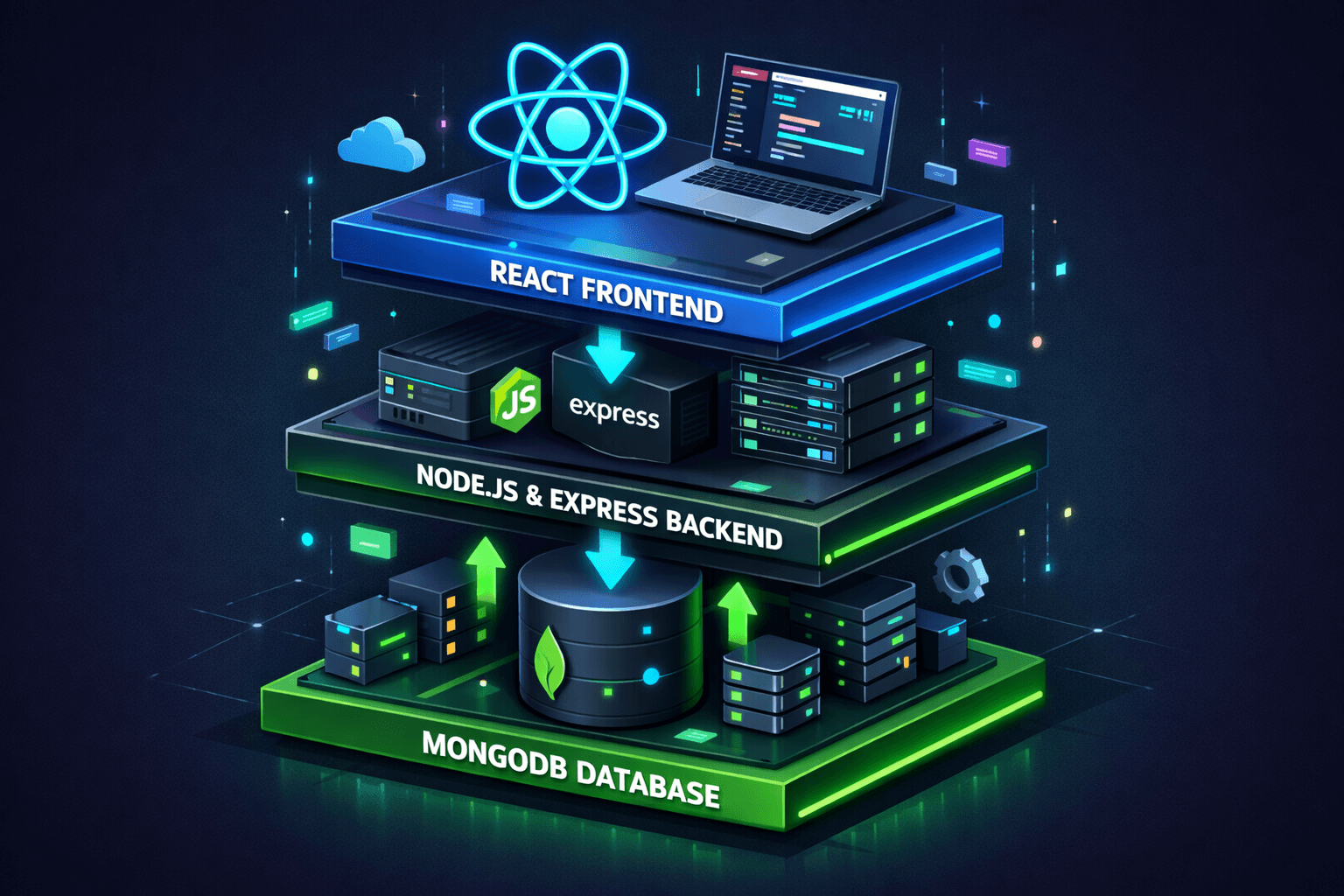
The MERN Stack is not a framework, and that distinction matters more than people admit. It’s a stack pattern built entirely around JavaScript, from database to browser. MongoDB handles data persistence, Express sits as the HTTP and middleware layer, React owns the UI and client-side state, and Node.js provides the runtime that ties the backend together.
What makes this combination powerful isn’t novelty. It’s coherence. Every layer speaks the same language. Your data structures don’t get reinvented every time they cross a boundary. JSON moves through the system without ceremony. A JavaScript object created in a React component can conceptually survive all the way to MongoDB Atlas and back without being mentally recompiled by three different engineers.
Here’s the thing people miss. MERN isn’t about “using JavaScript everywhere” as a philosophical statement. It’s about collapsing cognitive load. When the same mental model applies across frontend logic, REST APIs, Express middleware, and database queries, teams move faster because they think less about translation and more about behavior.
React hooks manage UI state. Node.js runtime handles concurrency and async IO. Express defines request lifecycles. MongoDB stores flexible documents that actually reflect how frontend apps think about data. This alignment is not accidental, and it’s not replaceable with a random mix of technologies.
MERN Stack architecture explained
MERN architecture is simple enough to sketch on a whiteboard and deep enough to scale to millions of users without rewriting the core idea. React lives entirely on the client, usually as a single-page application. It talks to a Node.js backend through REST APIs or GraphQL, though REST remains the default in most production systems I touch.
Express middleware becomes the traffic controller. Authentication, logging, rate limiting, validation, error handling, all of it composes cleanly because Express is just JavaScript functions chained together. No XML configs. No annotation soup. You read the code and you know what happens.
MongoDB sits behind that layer, often hosted on MongoDB Atlas because managing your own clusters is a waste of engineering hours unless you’re doing something truly exotic. The document model fits modern product requirements better than rigid relational schemas, especially when your frontend evolves weekly. You add a field, ship it, and move on. No migration theater every time product has a new idea.
What I like about MERN architecture is that it respects reality. Frontends change constantly. APIs change with them. Data models follow. MERN accepts this and gives you tools that bend instead of breaking. That’s not a hack. That’s maturity.
There’s a digression worth making here. People love to say document databases don’t scale or that they encourage sloppy data modeling. That’s mostly said by engineers who’ve never debugged a real production issue caused by premature normalization. Clean schemas matter, but pretending your data won’t change is worse than letting it evolve. MERN makes evolution cheap, and that’s the real architectural win.
Why companies use the MERN Stack
Companies don’t use MERN because it’s trendy. They use it because it compresses time. Time to market, time to iterate, time to onboard engineers, time to recover when something breaks at 3 a.m.
For startups building MVPs, MERN is brutally effective. One team can own the entire product surface area without context switching between languages and frameworks. Full-stack JavaScript isn’t a buzz phrase in that environment; it’s survival. When runway is limited, you don’t want a backend engineer waiting on a frontend engineer to “translate” requirements. You want one engineer shipping features end to end.
For larger companies, the appeal shifts slightly. MERN allows specialization without fragmentation. Teams can still focus on frontend or backend, but shared language and tooling reduce friction. A senior React engineer can read Node.js code and meaningfully review it. A backend engineer can jump into a React component without feeling lost. That cross-literacy pays dividends in code quality and incident response.
Scalability is another misunderstood angle. MERN scales horizontally very well when done right. Node.js handles IO-bound workloads efficiently. MongoDB Atlas scales with sharding and managed replicas. React handles complex UI state without server round trips for every interaction. Companies care less about theoretical benchmarks and more about predictable growth. MERN delivers that predictability.
There’s also hiring reality. JavaScript is the largest ecosystem in the industry. Finding engineers who understand the Node.js runtime, React hooks, and REST APIs is easier than assembling a Frankenstein team fluent in five unrelated stacks. Companies optimize for talent density, not academic purity.
Full-stack JavaScript in the real world
Full-stack JavaScript is often romanticized as a solo-developer fantasy. In practice, it’s a team multiplier. When everyone understands the full request lifecycle, from click to database write, design discussions become concrete. Bugs get fixed faster because ownership is clear.
I’ve worked on systems where frontend blamed backend, backend blamed database, and database blamed “the client.” MERN short-circuits that blame loop. When your stack is unified, excuses evaporate. Either the system works or it doesn’t, and the code that proves it is readable by everyone in the room.
React hooks deserve a specific callout here. They fundamentally changed how state is managed in large applications. When combined with a clean API layer built in Express, you get a system where UI logic and data flow are explicit. No magic. No hidden lifecycles. That transparency matters when products grow past the honeymoon phase.
Node.js gets criticized for being single-threaded by people who stopped reading after the first paragraph of the docs. The event loop model, combined with async IO, is exactly why MERN performs well under typical web workloads. Most applications are not CPU-bound. They’re waiting on networks, disks, or third-party services. Node.js excels there.
MERN versus traditional multi-language stacks
I’ll be blunt. Traditional stacks built on Java for backend, PHP for legacy services, Python for scripts, and JavaScript for frontend are organizational debt disguised as robustness. They require more documentation, more meetings, and more translators between layers.
MERN doesn’t eliminate complexity, but it localizes it. Complexity lives in business logic, not in the seams between technologies. That’s a healthier place for it.
When companies say they need “enterprise-grade” solutions, what they usually mean is predictability and support. MERN delivers both through maturity of tooling. Logging, monitoring, testing, CI pipelines, all exist and are battle-tested. The JavaScript ecosystem is chaotic, yes, but it’s also incredibly fast at converging on good ideas.
There’s an honesty to MERN that I respect. You see the stack. You see the trade-offs. You’re not hiding behind abstraction layers written in a different decade.
Web application development with MERN today
Modern web application development is less about pages and more about interactions. Single-page applications dominate because users expect instant feedback. React was built for this world, not retrofitted into it.
MERN supports this interaction-first mindset naturally. The backend becomes an API provider. The frontend owns user experience. The contract between them is explicit and testable. When done right, backend changes don’t break UI, and UI experiments don’t destabilize the system.
MongoDB’s flexible schema pairs well with this approach. Features can be prototyped quickly, validated, and either refined or discarded without costly migrations. This is why startup MVPs built on MERN often outpace competitors using heavier stacks. Speed compounds.
Security is often brought up as a concern, usually by people equating familiarity with safety. Express middleware patterns, JWT-based auth, and well-understood Node.js security practices are not experimental anymore. They’re standard. MERN systems are as secure as the engineers building them, which is true of every stack worth using.
The JavaScript ecosystem advantage
The JavaScript ecosystem is overwhelming, but that’s not a weakness. It’s a reflection of demand. Tools exist because problems exist. When you build on MERN, you’re tapping into an ecosystem that evolves alongside the web itself.
Libraries for state management, validation, testing, and performance optimization are constantly refined. You don’t wait years for language committees to approve features. You ship, measure, and iterate. Companies that understand this pace use MERN not because it’s comfortable, but because it’s aligned with how products are actually built today.
There’s a maturity curve here. Junior teams can ship quickly with MERN. Senior teams can build disciplined, scalable systems with the same stack. That continuity is rare.
Final thoughts from the trenches
I’m not saying MERN is the answer to every problem. I am saying that for web application development in 2025, especially products that live and die by iteration speed, MERN is the default that has to be disproven, not justified.
If you’re still arguing whether JavaScript can handle serious workloads, you’re late to the conversation. The companies shipping fastest already made that decision.
If you’re done wrestling with this yourself, let’s talk. Visit Agents Arcade for a consultation.
Iqra Majid is a full-stack JavaScript developer passionate about building modern web applications and AI-powered solutions. I write to share practical insights, real-world experiences, and lessons learned while building products in the tech space.