
Functions vs Arrow Functions: When to Use Which
At small scale, arrow functions feel like a stylistic choice. At large scale, they’re an architectural one. They influence how state flows, how methods are modeled, and how bugs surface months later. Treating them as interchangeable with regular functions is a mistake that only shows up once the codebase matures.
Most developers don’t notice this early. Everything works. Tests pass. The UI renders. The problem appears later, when behavior becomes implicit instead of intentional. When ownership blurs. When this stops being obvious and starts being guessed.
That’s usually when teams realize they’ve been writing modern JavaScript without actually thinking in JavaScript.
Why this confusion keeps resurfacing
Arrow functions were never meant to replace regular functions. They were meant to fix a specific class of problems: preserving lexical scope in places where JavaScript historically made it painful.
Somehow, that narrow solution turned into a default pattern.
I see this across mature codebases. Arrow functions everywhere. Object methods. Class methods. Utilities. Factories. Even APIs that clearly model behavior. All arrows. No distinction. No intent.
Here’s where people mess this up. They learn arrow functions as syntax, not semantics. Shorter syntax feels like progress. But JavaScript doesn’t reward minimalism. It rewards clarity around execution context.
If you don’t model that clearly, the language will happily let you ship broken assumptions.
difference between functions and arrow functions
The real difference is not cosmetic. It’s behavioral.
Regular functions create their own execution context. They get their own this, their own arguments, and they participate fully in JavaScript’s dynamic binding rules. They can be hoisted. They can be used as constructors. They belong on prototypes.
Arrow functions opt out of most of that.
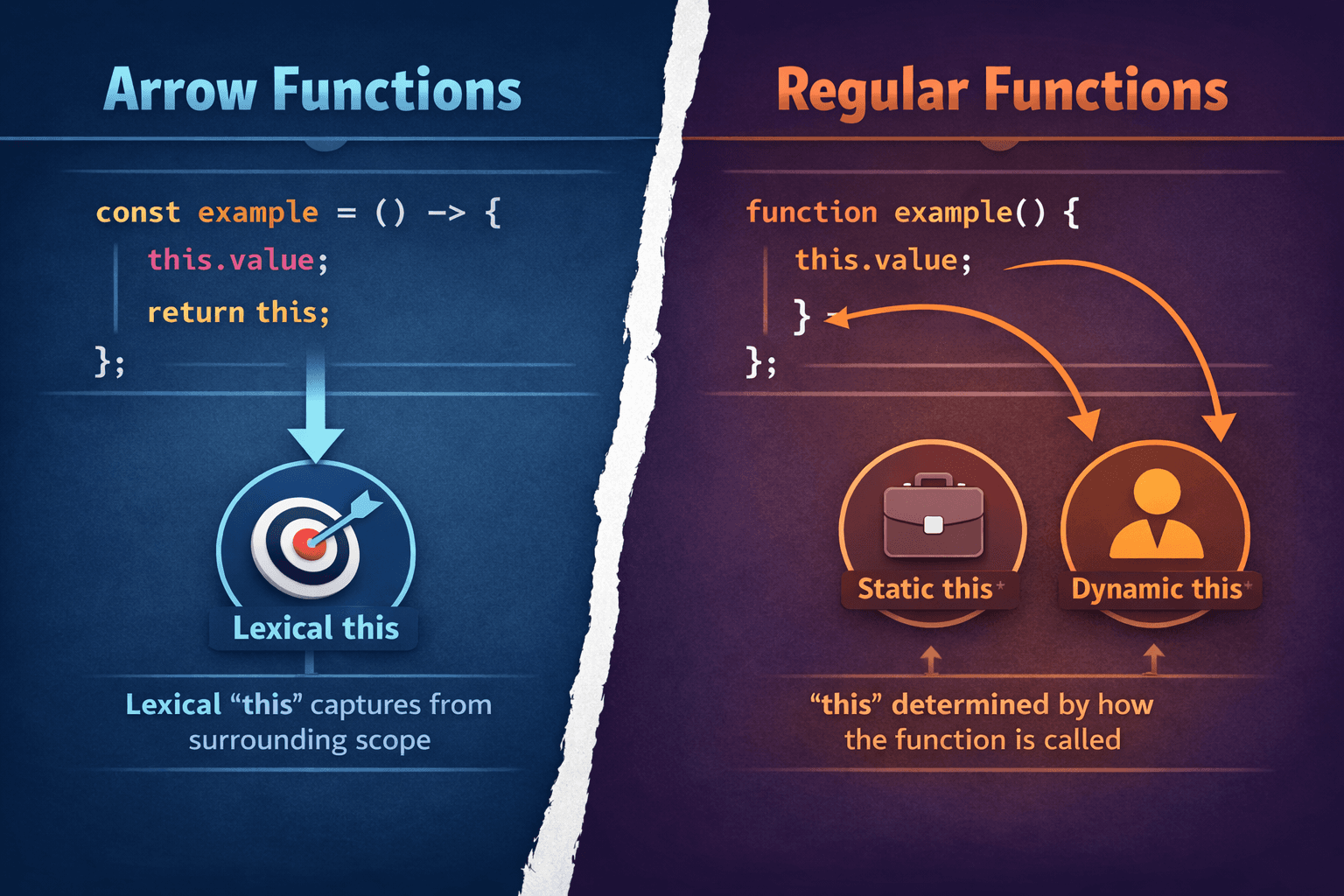
They do not have their own this. They capture it lexically from the surrounding scope. They do not have arguments. They cannot be used with new. They are not hoisted like function declarations.
This isn’t accidental. Arrow functions are closer to closures than to traditional functions. They are expressions, not behavioral units.
Once you understand that, the debate stops being philosophical and starts being practical.
The this keyword is the real fault line
Most production bugs tied to arrow functions aren’t caused by arrows themselves. They’re caused by misunderstanding this.
In a regular function, this is determined at call time. Method call? this is the object. Detached call? this is undefined in strict mode. Explicit binding? You control it.
Arrow functions refuse to participate in that system. They freeze this at definition time.
That makes them perfect for callbacks and async flows where you explicitly want context stability. It also makes them terrible when you expect call-site behavior.
And this is where experienced developers still get bitten.
arrow functions vs regular functions this
If a function is meant to act as a method, arrow functions are usually the wrong choice.
Methods are about receivers. They are called on something. Their behavior depends on that relationship. Regular functions model this naturally because this is dynamic.
Arrow functions don’t model receivers. They model capture.
When you write an arrow function as a method, you’re not defining behavior on an object. You’re defining a closure that happens to sit next to it. That distinction matters when you refactor, extend, or reuse logic.
I’ve seen this break event systems, service layers, and domain objects. The fixes are always reactive. Extra bindings. Wrapper functions. Refactors that shouldn’t have been necessary.
All because the original function type lied about intent.
when to use arrow functions in JavaScript
Arrow functions shine when the function is not the point.
Callbacks are the obvious case. Array iteration. Promise chains. Async workflows. Places where the function exists only to adapt data or glue steps together.
They’re also ideal for deeply nested logic where preserving lexical scope avoids noise. No rebinding. No self = this. No mental overhead.
In these cases, arrow functions are not just convenient. They’re correct.
Notice the pattern. Arrow functions work best when the function is disposable. When it’s not reused. When it doesn’t represent behavior, only flow.
The moment a function gains identity, responsibility, or longevity, you should pause.
Regular functions still define behavior
Despite modern syntax trends, regular functions are still the backbone of serious JavaScript systems.
If a function has a name, belongs to a module API, lives on a prototype, or represents an action, regular functions communicate intent better.
They signal that this matters. That the function stands on its own. That it can be reasoned about independently of its surrounding scope.
Arrow functions don’t offer that clarity. They intentionally blur boundaries.
That’s not a flaw. It’s just not what you want everywhere.
A necessary detour into legacy JavaScript
Before arrow functions, JavaScript forced developers to confront scope explicitly.
Patterns like var self = this weren’t elegant, but they were honest. You knew when context crossed a boundary. You felt it.
bind(this) was verbose, but it made ownership explicit. Binding wasn’t free. It was a conscious decision.
Arrow functions removed the friction. That’s good. But they also removed the moment where developers stopped and thought about context.
If you never experienced those older patterns, it’s easy to treat arrows as a universal upgrade. They’re not. They’re a shortcut — and shortcuts still require knowing the terrain.
Hoisting, arguments, and other quiet trade-offs
this gets all the attention, but it’s not the only difference.
Regular function declarations are hoisted. Arrow functions assigned to variables are not. In large or legacy codebases, that difference still matters.
Arrow functions also lack their own arguments. Rest parameters help, but they’re not always equivalent, especially in meta-programming or wrapper-heavy code.
And constructors. Arrow functions cannot be constructors. That alone disqualifies them from entire design spaces.
None of this is obscure knowledge. It’s just often ignored.
Event handlers and misplaced confidence
Event handlers are another common failure point.
Arrow functions feel safer because this stays predictable. But predictability isn’t always correctness.
In DOM and many framework APIs, regular functions deliberately bind this to the target. That behavior exists for a reason. Arrow functions discard it.
Sometimes that’s fine. Sometimes it quietly removes useful context and forces awkward workarounds later.
The issue isn’t arrows. It’s assuming safety without understanding cost.
Classes didn’t change the rules
ES6 classes made JavaScript look more familiar, but they didn’t change function semantics.
Defining class methods as arrow functions creates per-instance closures. Memory usage increases. Prototypes are bypassed. Overriding becomes harder.
There are cases where that trade-off is acceptable. But if it’s your default, that’s a red flag.
Methods belong on prototypes. That’s still true. Arrow functions inside classes are not methods. They’re captured behavior.
JavaScript hasn’t changed its mind about that.
Closures, intent, and maintainability
Closures are powerful. Arrow functions make them easier to write — and easier to overuse.
A codebase filled with arrows can look clean while hiding complex scope relationships. State leaks. Context becomes implicit. Refactoring becomes risky.
Regular functions introduce friction. That friction is often what keeps systems understandable.
As a senior engineer or architect, this isn’t about preference. It’s about long-term readability and correctness.
A firm conclusion, because hedging helps no one
Arrow functions are not a default replacement for regular functions. Using them as such is sloppy engineering.
Use arrow functions when you need lexical scope. Use them for callbacks, adapters, and control flow.
Use regular functions when modeling behavior, defining APIs, writing methods, or anything where this, hoisting, or reuse matters.
JavaScript rewards deliberate choices. It punishes cargo-cult patterns.
Don’t let function misuse slow your projects. Reach out to Agents Arcade for a consultation today.
Iqra Majid is a full-stack JavaScript developer passionate about building modern web applications and AI-powered solutions. I write to share practical insights, real-world experiences, and lessons learned while building products in the tech space.